Get Full Government Meeting Transcripts, Videos, & Alerts Forever!
Get email alerts on the Police Staffing Drop topic
No spam. Unsubscribe anytime.
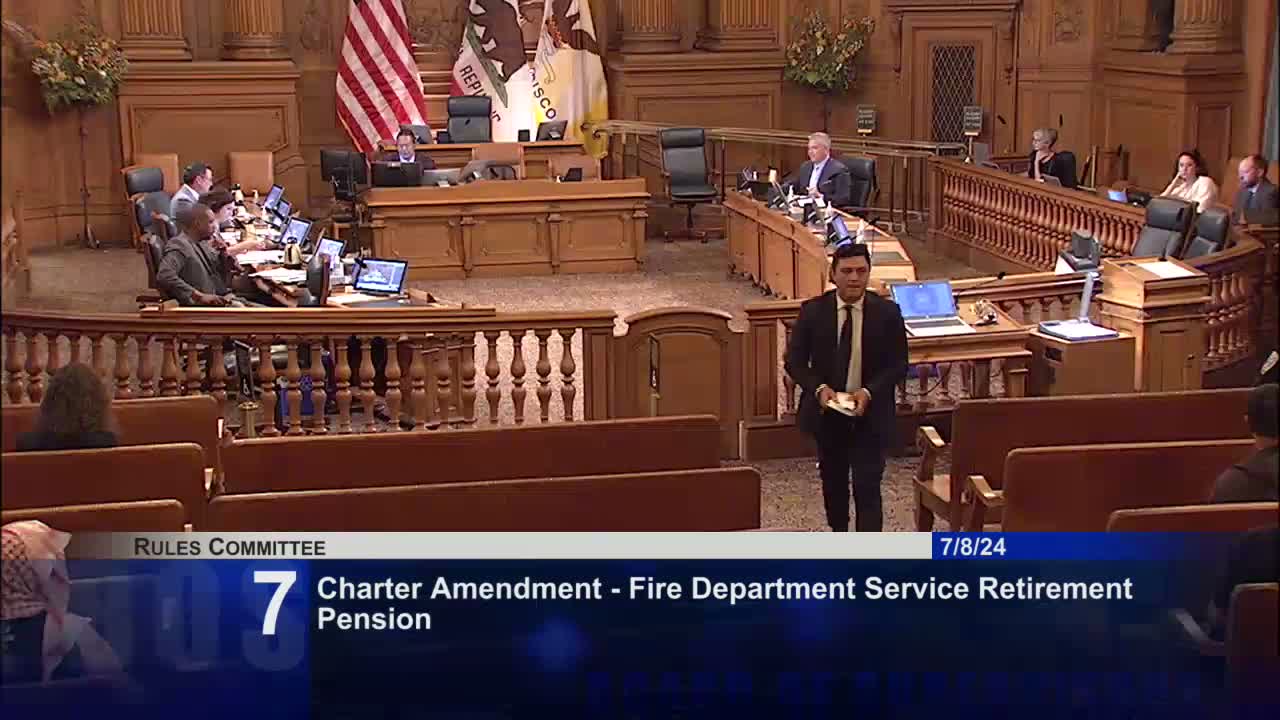
Rules Committee narrows police DROP proposal, removes minimum staffing number and continues measure for further cost and data review
Summary
Supervisor Dorsey offered a revised police staffing and DROP charter amendment that removes a hard minimum staffing figure, shifts Prop E workload assessments to a three‑year cycle, and refocuses DROP eligibility on neighborhood patrol or investigative work; the committee accepted amendments and continued the item to July 15 after controller cost estimates and extended questioning.
Supervisor Matt Dorsey presented an amended charter proposal to address sworn‑officer recruitment and retention. The revised draft removes a hard minimum‑staffing number from the charter, instead requiring annual reporting by the Police Commission and shifting Prop E workload assessments from every two years to a three‑year cycle beginning after the fall 2025 assessment. The measure also proposes a five‑year DROP (Deferred Retirement Option Program) limited to certain ranks and narrowly tied to neighborhood patrol or investigative assignments.
Dorsey said the goal is to retain experienced officers for operational patrol and investigations and to reduce incentives for senior leaders to occupy non‑patrol desk roles at the end of their careers. Deputy Chief Walsh of SFPD said the department would provide information to the committee and emphasized the department’s neutrality on ballot measures: “Obviously, we don't take positions on ballot measures.”
Controller Greg Wagner presented the budget analysis. He told the committee that, under the amended measure, the primary fiscal impact would be on the retirement system and that estimated retirement‑system cost ranges are "between $600,000 and $3,000,000 in the first year," varying with behavioral responses. He also noted prior versions that included minimum staffing would have required much larger estimates; removing minimum staffing from the charter removed that large direct budgetary requirement from the controller’s cost estimate.
Supervisors pressed for additional data—committee members asked whether officers who retire are subsequently hired by other jurisdictions, how many officers are eligible in coming years, and whether DROP would materially delay retirements or merely shift payments. Chief department witnesses provided headcounts and scenarios (the draft legislative analyst estimate suggested DROP could delay roughly 50 retirements in 2025 and additional numbers in following years). After extended questioning about data and fiscal impacts, the committee voted to amend as proposed and continue the matter to July 15 for additional cost and operational detail.
Next steps: Staff will provide additional comparative and behavioral data and a refined fiscal analysis prior to the July 15 committee meeting; the committee will reconvene for final action.