Get Full Government Meeting Transcripts, Videos, & Alerts Forever!
Get email alerts on the Acoc Fundraising Budget topic
No spam. Unsubscribe anytime.
Controller: ACOC has documented about $13.9M; city projects a possible $2.6M shortfall under current assumptions
Summary
The controller reported $13.9 million in documented cash and pledges for the America's Cup organizing committee versus a $32 million host/venue target; OEWD presented a city expense projection of about $22.5 million with reimbursements and tax revenue assumptions that leave an estimated $2.6 million shortfall under current projections.
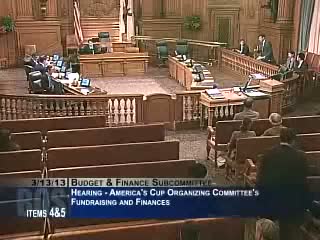
The San Francisco controller and city staff told supervisors on March 13 that the America's Cup organizing committee (ACOC) had documented roughly $13.9 million in cash and written commitments as of the committee's update, short of the $32 million fundraising target in the host and venue agreement.
Controller Ben Rosenfield said about $12 million of the $13.9 million had been received in cash. He noted much of those funds were accelerations or loans derived from the event authority itself rather than independent philanthropic or corporate pledges.
Mark Buell, chair of the ACOC, and Carrie McClellan, the ACOC CEO, described recent fundraising recalibrations. Buell said the organizing committee had increased pledges by approximately $1.9 million since last year and reported a $150,000 addition the previous week. McClellan described a local corporate‑donor program called "1SF: Celebrating the Cup," mayor‑led outreach and roughly $2 million in verbal commitments the mayor and the fundraising council were converting to written pledges.
OEWD's America's Cup project director Mike Martin presented city invoicing and budget projections. The city has invoiced approximately $8.37 million for event‑related expenses and received about $6.8 million in reimbursements, leaving roughly $1.5 million outstanding. Martin's forward‑looking budget for this fiscal year and next totaled about $22.5 million; when OEWD subtracted reimbursements and the event‑related tax revenue projection (about $13 million in the updated economic analysis), the residual gap on Martin's breakeven slide was about $2.6 million under the assumptions shown to the committee.
Martin noted some items are variable — including spectator counts, which different analyses estimate between 2 million and earlier higher figures — and that the city expected to truth‑test visitor counts and tax impacts during events. The budget projection also counts a $2.4 million cash collateral escrow that the city expects to recover if not drawn upon.
John Haveman of the Bay Area Council Economic Institute presented an updated impact study that reduced prior 2010 estimates. The institute's revised analysis estimated approximately $900 million in direct and indirect economic activity and about 6,481 full‑time‑equivalent jobs (down from earlier projections of ~8,800), and estimated roughly $13 million in city tax revenues under the updated spending assumptions. Haveman said the update excluded some potential additional revenue streams — such as concert series or the Red Bull Youth event — because those were undefined or lacked historical comparables.
Supervisors said they were encouraged by the economic potential but pressed for clarity about whether private fundraising would cover projected city costs; the Controller and ACOC said they would continue to pursue pledges and convert verbal commitments to written pledges and payments. The committee continued Items 4 and 5 for follow‑up reporting.