Get Full Government Meeting Transcripts, Videos, & Alerts Forever!
Get email alerts on the Five Year Financial Plan topic
No spam. Unsubscribe anytime.
San Francisco budget office flags $487 million five-year shortfall; proposes mix of savings, slower growth and new revenues
Summary
Mayor—s budget director told the Board of Supervisors Budget & Finance Committee the city faces a $487 million five-year gap, noting revenue growth of roughly $578 million but expenditure growth of about $1.1 billion; proposed strategies include departmental savings, limits on non-personnel inflation, reduced capital baselines and possible new revenue such as a local VLF estimated at $55M.
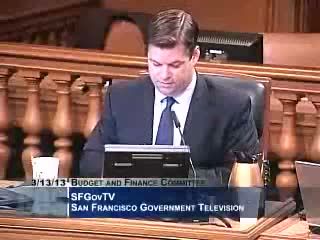
Kate Howard, the mayor—s budget director, told the San Francisco Board of Supervisors Budget and Finance Committee on March 13 that the city—s proposed five-year financial plan projects a $487,000,000 structural gap and outlines a mix of cost controls and revenue options to close it.
The plan—s base case assumes the FY2013-14 budget adopted last year as the starting point and projects roughly $578,000,000 of revenue growth over five years while estimating expenditures will grow by about $1.1 billion, driven largely by salary and fringe benefit costs. "The plan identifies a gap between revenues, and expenditures over the 5 year period of $487,000,000," Howard said.
Why it matters: the gap reflects a structural imbalance the administration says requires a combination of strategies rather than one-time fixes. The presentation said the mayor—s office and controller—s staff jointly prepared the projections and that the plan assumes conservative revenue growth in years three through five to reflect economic uncertainty.
Major drivers and assumptions - Capital funding: the adopted FY13-14 budget included about $40 million of general-fund capital support, while the capital plan the city—s capital planners recommended is roughly $80 million, creating a notional $40 million annual shortfall if fully funded going forward. Howard said the five-year plan resets capital spending to the $40 million baseline and then grows from there. - Wages and benefits: the plan projects roughly $460 million in additional salary and fringe costs over five years. Howard said about $220 million of that is salary; the rest is benefits and pension-related costs. She noted roughly $100 million of additional pension contribution costs are expected over the next two years. - Departmental pressures: the Department of Public Health (DPH) is the city—s largest general-fund department and carries significant projected shortfalls. Howard said a supplemental cost projection of about $141.9 million underlies the DPH outlook and that opening the new San Francisco General Hospital contributes large one-time and operating costs.
Proposed strategies Howard said the plan recommends slowing budget growth from the projected 25% over five years to about 16% through a mix of policies: resetting capital baselines, pursuing ongoing departmental savings (a 1.5% ongoing savings target per department annually), limiting non-personnel inflation and nonprofit COLAs in the first two years, and pursuing additional revenues through fees or taxes when appropriate. "We need to manage our growth over the next 5 years, not that we don't grow at all," Howard said.
Revenue options and politics The plan includes an assumption of about $55 million in additional annual revenue beginning in FY15-16, an amount Howard said is equivalent to a local vehicle license fee (VLF) if the city chooses that option but could come from other sources. Supervisor Scott Wiener raised concerns that a statewide VLF measure would be a general fund tax and could not be legally dedicated absent an accompanying measure, adding that voter confidence would be required if residents expect the revenue to be dedicated to transit or road resurfacing.
Public comment and nonprofit concerns Debbie Lerman of the San Francisco Human Services Network urged the board not to assume zero CPI for nonprofits and said flat funding for nonprofits "was a fantasy," asking the city to include nonprofit cost pressures in deliberations and to engage nonprofits as part of solutions.
Next steps Howard said the committee was receiving the plan for discussion and that any formal actions would return when the capital and IT plans are considered. The committee moved to continue item 1 to the call of the chair without opposition.
Speakers quoted or cited in this article include Kate Howard (mayor's budget director), Chair Mark Farrell, Supervisor Scott Wiener and Debbie Lerman (San Francisco Human Services Network).