Get Full Government Meeting Transcripts, Videos, & Alerts Forever!
Get email alerts on the Pay Equity topic
No spam. Unsubscribe anytime.
Supervisors hear hours of testimony on proposed pay changes for 45 classifications; committee files the item
Summary
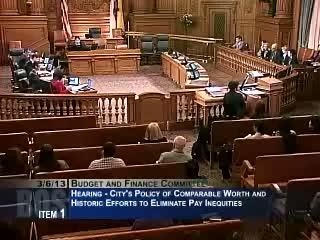
A March 6 hearing on comparable worth and proposed Department of Human Resources pay adjustments drew extensive testimony from supervisors, DHR and dozens of city workers and union representatives who warned that a proposal affecting 45 classifications would disproportionately harm women and people of color; the committee voted to file the item without opposition for further review.
The Budget & Finance Committee on March 6 held a lengthy hearing on the city’s policy of comparable worth and a Department of Human Resources (DHR) proposal that supervisors and union leaders said could reduce base pay rates for 45 job classifications disproportionately held by women and people of color.
Sponsor Supervisor John Avalos opened the hearing with a call to examine whether recent DHR proposals would reverse decades of pay‑equity gains the city made after Proposition H (1986). Avalos presented charts comparing historically undervalued classes (e.g., licensed vocational nurses, custodians, eligibility workers) to their comparable counterparts and said some new‑hire pay proposals would ‘‘lower the pay’’ for those classes and widen existing gaps.
Maura Keeley, who said she worked as a legislative coordinator for the union during the original 1981 effort, told the committee the 1981 Board declaration against wage discrimination "stood independent of any particular implementation approach" and warned against reintroducing two‑tier systems. DHR Director Nikki Callahan said the department’s proposals reflect charter changes and collective bargaining outcomes and are not meant to be "an attack on comparable worth," arguing DHR must balance market surveys, recruitment difficulties and contractual obligations. Callahan said DHR used a standard Bay Area labor market (nine counties plus cities of 100,000 or more) and limited adjustments to classifications that are more than 15% over market.
A long public comment period followed. Dozens of workers, union leaders and community groups — including SEIU Local 1021 members, nurses, custodians and food service workers — described daily job duties, safety risks, the difficulties of living in San Francisco on current wages and the historic role of Proposition H in protecting pay equity. SEIU and labor council representatives warned any rollback would be politically and legally contested and urged supervisors to oppose cuts. Examples from testimony: Arlette Smith (child protective services worker) said her classification is one of the 45 targeted and described dangerous working conditions and high caseloads; Jamila Dinh (food service worker) said city market comparisons omit relevant local employer conditions; Larry Bradshaw (SEIU) said an arbitrator must choose either the city or union proposal under charter section 8.409 and warned the union would not agree to remove pay equity gains.
Committee members expressed concern about the potential for disproportionate impact and asked DHR for more data and context on how classifications were matched and why targets moved over time. After public testimony, Chair Mark Farrell accepted a motion to file (close) the hearing record; Avalos underlined the need for continued review. The committee filed item 1 without opposition, which preserves the record for further oversight and possible future action but does not enact any change to pay scales at this meeting.