Get Full Government Meeting Transcripts, Videos, & Alerts Forever!
Get email alerts on the Moscone Expansion topic
No spam. Unsubscribe anytime.
Committee backs starting process for Moscone Center expansion assessment district
Summary
The committee approved an amendment of the whole and forwarded to the full Board a resolution of intent to form a Moscone Expansion Assessment District to help finance a proposed ~$500M expansion, with a two‑zone hotel assessment and a city contribution phased from $8.2M to $10.7M per year in later years.
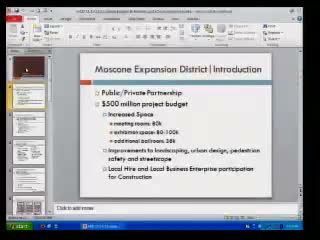
Officials from the Convention Facilities Bureau, San Francisco Travel, the Tourism Improvement District (TID), the Office of Economic and Workforce Development and the Controller’s public‑finance team presented a plan to form a Moscone Expansion Assessment District (MED) that would fund a large share of a proposed Moscone Center expansion. The project budget was estimated at roughly $500 million to add exhibition and meeting space and a new ballroom to keep San Francisco competitive for major conventions.
Under the proposed two‑zone assessment, Zone 1 hotels (east of Van Ness and north of 16th Street) would be assessed at a proposed 1.25% of room revenue (0.5% for July–Dec 2013 while an existing TID Moscone renovation assessment sunsets), and Zone 2 hotels (west or south of those boundaries) at 0.3125%. Petitioning by hotels had generated weighted support above the 50 percent threshold required to begin the formation process (about 53.97% weighted in favor at the time of the hearing); ballots will be mailed in a 45‑day balloting window if the full Board adopts the resolution of intent.
The city’s proposed financing plan includes issuing certificates of participation (COPs) repaid primarily from MED assessments, an MED incentive fund to attract conventions, a capital reserve for future maintenance, and a stabilization fund sized at $15 million to weather potential revenue volatility. The city also proposed an ongoing annual general‑fund contribution — historically about $8.2 million — that staff would continue for the expansion and that could ramp to $10.7 million in later years as debt is repaid.
The committee adopted a non‑substantive amendment of the whole (technical clarifications and the inclusion of financing terms) and accepted the budget analyst’s recommendation that the resolution include detailed management‑plan attachments and that the Board recognize the policy tradeoffs inherent in the proposed multi‑decade district and bond financing. Several hotel‑industry and tourism speakers testified in favor; neighborhood commenters urged strong neighborhood representation in design review and attention to pedestrian and traffic impacts. The committee forwarded the resolution and the proposed local ordinance amendment (to allow longer district terms when used to secure bonded financing) to the full Board with recommendation. Ending: the Board will consider the resolution of intent, a public information meeting and a ballot tabulation schedule in the coming months as the formal formation and validation process proceeds.