Get Full Government Meeting Transcripts, Videos, & Alerts Forever!
Get email alerts on the Overtime topic
No spam. Unsubscribe anytime.
Supervisors press SFMTA to curb overtime after agency projects $57M year-end expense
Summary
The committee heard MTA staff describe drivers of an overtime overrun that pushed year-end projections to about $57 million, and MTA committed to a written overtime policy and 10''15% reduction targets tied to data audits, hiring part-time operators and charging overtime to capital projects.
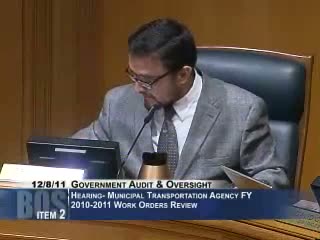
The Board of Supervisors'' Government Audit & Oversight Committee on Dec. 8 considered a resolution asking the Municipal Transportation Agency to adopt a formal policy to reduce overtime overruns in FY 2011-12 and subsequent years.
Supervisor David Campos introduced the resolution, citing citywide overtime of more than $90 million in FY 2010-11 and saying MTA accounted for a disproportionate share. MTA administration described the causes and an action plan: Deborah Johnson, MTA director of administration, said the agency budgeted about $32 million for overtime in FY12 but projected a year-end expense near $57 million, with drivers that include scheduled industry-standard overtime, staffing shortages, deferred maintenance, special events and incident responses.
MTA outlined operational steps to reduce overtime: better data collection and reporting (division-level audits and a checklist for billing and overtime review), expanding part-time operator hiring enabled by recent labor agreements, charging overtime to capital projects where appropriate (for reimbursable special-event or construction activity), right-sizing staffing and increased use of part-time operators and new internal controls that require division director authorization for overtime exceptions.
On targets, MTA presented a goal range of a 10''15% reduction in overtime over the coming year, estimating savings of roughly $5'—0 million. Supervisors pressed for a firm basis for the percentage target and an accountability structure; MTA said division directors and the director of transportation would be collectively responsible and that the agency would report trend data after a quarter of implementation (March' pril timeframe).
Community members who testified supported reducing overtime and urged collaboration with unions to create part-time positions. The committee took the resolution forward without objection and asked MTA to return with data on implementation and progress in spring 2012.
What happens next: MTA will publish overtime reports to division directors, implement a formal overtime policy and return to the committee with quarterly trend data on overtime reductions and the effect of hiring and schedule changes.