Get Full Government Meeting Transcripts, Videos, & Alerts Forever!
Get email alerts on the Whistleblower Program topic
No spam. Unsubscribe anytime.
Grand jury finds whistleblower system needs overhaul; Controller accepts many recommendations but flags legal limits
Summary
The civil grand jury urged reforms to San Francisco's whistleblower program, citing poor follow-up, confidentiality problems and retaliation concerns. Controller Ben Rosenfield agreed with several recommendations and proposed enhanced tracking and public summaries but identified legal and practical limits to others (e.g., naming respondents, mandatory internal investigations, reward payments).
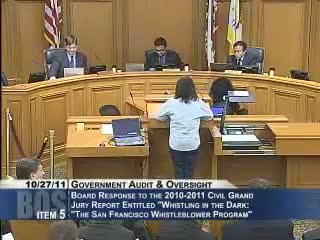
The civil grand jury presented "Whistling in the Dark," a report concluding that San Francisco's whistleblower program needs structural reforms to better protect complainants and to increase transparency and follow-up. The committee heard the grand jury's findings and then a detailed response from Controller Ben Rosenfield and comments from the Ethics Commission.
Hulda Garfolo, who chaired the grand jury committee, told the panel the jury examined a sample of 364 complaint records out of 804 complaints filed during the review period and found shortcomings: inconsistent follow-up, marketing materials with outdated information, routing complaints back to the department alleged to have committed wrongdoing, and a perception among whistleblowers that retaliation is not adequately remedied. "Whistleblowers are honest people who are forced to become like islands of isolation," Garfolo said.
Controller Rosenfield thanked the grand jury and said he agreed in whole or in part with eight of the 14 recommendations, described steps the Controller's Office is already taking (assigning tracking numbers, improving internal case tracking, upgrading website guidance and examples, strengthening outreach to departments and employees, and enhancing GOBOC oversight), and said the office will publish summaries of substantiated complaints consistent with state law. He rejected four recommendations as impractical or inconsistent with standard practice, including a proposal that all investigations be conducted entirely in-house and a recommendation to create financial rewards for substantiated complaints, citing risks of unintended consequences. The Controller emphasized that California law limits public disclosure of respondents' names for these investigations.
John St. Croix of the Ethics Commission explained that the commission handles retaliation claims but generally lacks restorative powers (it can impose punitive measures but not reinstate employees or restore lost pay), which helps explain why many whistleblowers pursue union remedies or civil litigation. He said retaliation cases are relatively few and that roughly half of the small number of matters filed with the Ethics Commission find no retaliation.
Whistleblowers from Laguna Honda Hospital and other agencies testified in public comment about alleged retaliation, delayed investigations and lack of redress; several urged stronger protections, clearer public reporting of sustained findings, and a different adjudicatory path for retaliation claims. Dr. Derek Kerr described being laid off after raising concerns and said he was told by Ethics Commission staff to seek private counsel.
Committee members expressed support for many of the grand jury's proposed improvements while noting limits imposed by law, the Controller's current resource constraints and the practical trade-offs of diverting all investigations in-house. The committee asked staff to work on specific implementation details, including options for appeals and remedies that would offer more meaningful protection against retaliation while conforming to state law and available remedies.
The committee recorded its positions on specific findings and recommendations (agreeing with many findings about program weaknesses, and disagreeing with some recommendations that would require charter changes or entail unintended consequences). Members thanked the grand jury and the Controller for their work and signaled ongoing oversight and possible legislative options to strengthen whistleblower protections and reporting.