Get Full Government Meeting Transcripts, Videos, & Alerts Forever!
Get email alerts on the Central Subway topic
No spam. Unsubscribe anytime.
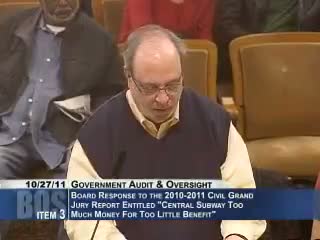
Civil grand jury criticizes Central Subway design and MTA responses; MTA and TA defend project and federal funding timeline
Summary
The civil grand jury presented a report critical of the Central Subway's design, projected costs and some MTA responses; MTA, the Transportation Authority and the Mayor's office defended the project, citing decades of review, federal funding under review and projections for high ridership and contingencies. The committee agreed with a subset of the grand jury's findings on Muni performance and finance while rejecting others.
The Government Audit and Oversight Committee heard a presentation from the civil grand jury on its report "Central Subway: Too Much Money for Too Little Benefit," followed by detailed responses from the Municipal Transportation Agency, the Transportation Authority and the Mayor's office. The grand jury said its fact-based investigation (50'60 pages of analysis and interviews) found design shortcomings, questionable cost-effectiveness, and weaknesses in MTA's responses to findings — but did not recommend a surface-street alternative or that the project be canceled outright.
Grand jury chair Bob Perry said the jury verified facts from MTA documents and interviews and emphasized that while the report criticizes the current subway design, it does not dispute the utility of having a subway to Chinatown; rather, the jury disputed aspects of the current design and some MTA justifications. Daniel Schweitzer highlighted several findings, including low on-time service performance for Muni (Prop E targets), and flagged a projected shortfall in light-rail vehicles during the 2018'19 peak period based on documents provided to the jury.
MTA Executive Director Ed Riskin framed the Central Subway as the product of more than two decades of planning and environmental review and said the project has been heavily vetted by federal reviewers. John Fungi, Central Subway Program Director, reviewed program milestones: acquisition of key real estate (Chinatown station property), three major construction contracts underway, tunnel contract awarded for about $233,000,000 (reported to be under budget by $13,250,000 in MTA remarks), final design near 90% complete, and an application for a full funding grant agreement submitted to the Federal Transit Administration on Sept. 19.
Fungi provided the program budget history: the project was originally costed at about $1.3 billion, an FTA risk-assessment recommended higher contingency ($278 million), and federal contributions thereafter raised the program budget to $1.578 billion with current contingency reported at about $264 million. MTA projected opening-day ridership of roughly 44,000 riders per day and longer-term daily ridership near 65,000; the agency argued the project is one of the most intensively used light-rail corridors on a per-mile basis.
Jose Luis Moskovic, Executive Director of the San Francisco County Transportation Authority, emphasized the regional and federal funding context: the New Starts process is multi-year and regionally prioritized, local match for federal funds has largely been committed during Phase 1, and cancelling the project at this stage would likely forfeit federal funds. The Mayor's office (Johanna Parton) said the Mayor strongly supports the project, underscored ridership and time-savings claims (for example, reducing Chinatown-to-Caltrain travel from about 20 minutes to 8) and highlighted job creation and regional coordination.
Public comment was extensive and split. Critics and neighborhood groups urged independent audits, questioned ridership numbers and connectivity to Market Street and Powell Street stations, and raised concerns about cost escalation (speakers referenced figures ranging from initial $650 million estimates up to $1.6 billion). Supporters, including business groups, labor unions and community advisory members, stressed decades of planning, anticipated economic benefits and the risk of losing large federal funds if the project were halted.
After presentations and public comment, the committee considered a resolution responding to specific grand jury findings and recommendations focused on Muni operations and finance (not redesign specifics). Supervisor Mark Farrell moved that the committee agree with the cited grand jury findings and recommendations with the exception of recommendation 4; President David Chu seconded and the committee took the matter without objection.
The exchange left the committee's position: the Board will endorse scrutiny of Muni management and finances while the City's transportation agencies proceed with implementing the project and pursuing federal funding. The committee and staff signaled ongoing oversight, including follow-up on financial management, contingency planning and performance audits.