Get Full Government Meeting Transcripts, Videos, & Alerts Forever!
Get email alerts on the Audit Followup topic
No spam. Unsubscribe anytime.
Controller summarizes audit follow-ups; fire, police and PUC outline steps and outstanding recommendations
Summary
The Controller's Office reported on follow-up activity for multiple departmental audits, detailing open, contested and closed recommendations. Fire and police acknowledged documentation and control gaps; the Public Utilities Commission said it is upgrading lease administration and inventory systems to address dozens of open recommendations.
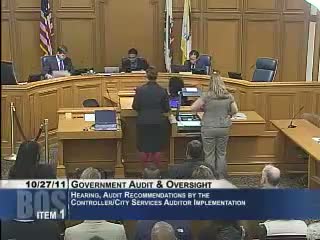
The Government Audit and Oversight Committee on Oct. 27 heard an update from the Controller's Office on departments' progress implementing City Services Auditor recommendations. Tanya of the Controller's Office summarized the office's three-stage follow-up process (six months, one year, two years) and described the status categories the office uses: Active (no response yet), Open (response received but recommendation remains outstanding) and Closed (CSA has determined the department's actions resolve the finding).
The Controller's Office said it did follow-up on 14 audits during the third quarter: eight were closed, six remain open and three PUC items were awaiting PUC's follow-up. The office described several audits that remain of concern, including a Fire Department payroll audit with 20 recommendations (20 open, 4 contested, 6 closed). Controller staff said audit testing of retiree payouts found inconsistent application of a sick-leave cap and a wellness incentive calculation that produced a higher payment for one retiree because the department applied the cap at a different point in the calculation. Controller staff said the department must either produce the underlying settlement document cited as an exception to the cap or adopt a consistent written procedure for calculating payouts.
Deputy Chief Monica Fields of the San Francisco Fire Department told the committee the department does not have copies of some historical settlements; "we are not in possession of that document," she said, adding that the department has resurrected internal tracking systems for hazmat pay and acting assignments and is working with the City Attorney and the Controller's Office to resolve the issues.
On police overtime controls, Captain Pardini explained the Police Department's practice for off-duty (10b) assignments: clients sign a verification at the job site and supervisors review compensation requests later. The department opposes requiring officers to sign in at the station before and after private assignments because it could expand compensable time and create new overtime exposures. "We feel if we put in this added layer, it's going to be problematic," Pardini said, describing the existing paper verification and supervisory review process.
The Controller's Office also reviewed several Public Utilities Commission audits. Controller staff said Sonoma Valley Golf and Recreation Company audits show open recommendations tied to unpaid rent and late fees (the office identified about $11,000 of potential underpayment). For Hansen aggregates (wastewater enterprise) the office reported 48 open recommendations and categorized the risk as high; the audit identified recovered subtenant rent of $40,000 but noted about $120,000 identified by auditors has not yet been collected. For Crystal Springs Golf Partners the audit identified $72,000 in uncollected late charges. Nancy Hom, PUC's Director of Assurance and Internal Controls, said some responses are in routing and that PUC is optimizing an inventory system (Maximo), adopting barcode entry and tighter monitoring at warehouses.
Joyce Hicks, Executive Director of the Office of Citizen Complaints, told the committee OCC has implemented the substance of most recommendations from a 2007 audit but still needs resources to meet three contested items. Hicks said OCC investigators carry heavy caseloads (about 30 cases each) and that adding four journey-level investigators would be needed to reduce caseloads toward the controller's benchmark. Hicks also noted limited discretionary budget for small IT improvements: "it would cost us $12,000" to add an automated tickler; online complaint filing was estimated at $7,000 but OCC lacks discretionary funds in its roughly $4.3 million budget.
The committee asked departments to return with additional documentation and follow up with the City Attorney where legal authority or historical settlements are missing. Chair David Campos said the committee will continue these follow-ups to ensure departments implement recommendations and recover amounts due to the city.