Get Full Government Meeting Transcripts, Videos, & Alerts Forever!
Get email alerts on the Health Care Security Ordinance topic
No spam. Unsubscribe anytime.
Committee forwards Campos' bill to close HCSO "use-it-or-lose-it" loophole to full Board
Summary
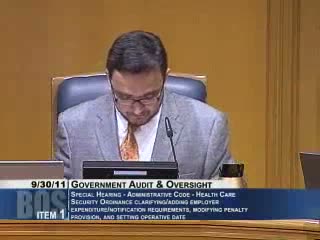
The Board of Supervisors' Government Audit and Oversight Committee on Sept. 30 forwarded Supervisor David Campos' proposal to close a loophole in the Health Care Security Ordinance that critics say lets some employers keep money earmarked for workers' health benefits. The measure goes to the full Board Oct. 4.
SAN FRANCISCO — The Board of Supervisors’ Government Audit and Oversight Committee voted Friday to send Supervisor David Campos’ proposal to the full Board after hours of testimony from workers, labor leaders and business owners about how Health Reimbursement Accounts (HRAs) are being used under the city’s Health Care Security Ordinance (HCSO).
Supervisor David Campos, who introduced the ordinance change, told the committee the measure is aimed at ensuring money that consumers are asked to pay for workers’ health care actually reaches those workers. “Childbirth, dollars 16,000,” Campos said, noting that workers who can accumulate only about $4,000 in some accounts remain unable to pay for even routine procedures. Campos said a small minority of employers use HRAs in ways that deny workers access and that consumer surcharges sometimes do not fund employee care.
Why it matters: Supporters — including labor unions, legal aid groups and health advocates — said allowing HRA funds to roll over year to year would permit low‑wage workers to accumulate meaningful sums to buy into Healthy San Francisco or private insurance. Opponents — business groups and some small employers — warned the proposal could tie up tens of millions of dollars, increase costs for fragile employers and lead to layoffs.
Mayor’s office alternative: Jason Elliott, speaking for the mayor’s office, said the mayor agrees a loophole exists but urged a time-limited, data-driven approach. Elliott described a proposal to make HRA deposits irrevocable for a set period (he said conversations had considered six quarters, or 18 months) while the Office of Labor Standards Enforcement surveys employers and employees to determine whether HRAs are being restricted from buying insurance or enrolling in Healthy San Francisco. “The mayor believes deeply that this is a loophole and this loophole does need to be closed,” Elliott said, while urging a policy that preserves access and minimizes unintended impacts on small businesses.
Public testimony: The committee heard intimate accounts from workers and broad endorsements from labor and advocacy groups. An unidentified worker described battling for months to secure HRA reimbursements from an employer and a third-party administrator until escalating his complaint and confronting corporate leadership; he said he only received a partial reimbursement after prolonged effort. Mike Casey of the San Francisco Labor Council said the legislation would address consumer fraud, level the playing field and provide real care for working families. By contrast, Steve Falk of the Chamber of Commerce and several small-business owners warned the ordinance could exacerbate job losses already suffered during the economic downturn.
Consumer-protection and enforcement concerns also surfaced. Campos cited reporting by the Wall Street Journal that some establishments collected sizable surcharges while remitting little to employees. Industry representatives said the facts differ by firm and urged precise targeting of abusive practices rather than a broad mandate that could burden many compliant businesses.
Procedure and next steps: After discussion of competing amendments and alternatives, the committee agreed to forward item 110,998 to the full Board as a committee report for an up-or-down vote Oct. 4. President Chiu moved the motion; it was seconded and taken without objection. The full Board may consider amendments or alternative language from the mayor’s office and supervisors before voting.
What remains unresolved: Committee members and witnesses disagreed about whether the existing data are sufficient to justify immediate legislative change or whether a time-limited study and irrevocability period should precede a permanent rule. The mayor’s office said it would supply written language and data collection plans; Campos and supporting advocates said the city already possesses evidence of abuse and urged prompt action.
The committee adjourned after the motion to forward the matter was approved. The item is scheduled for the Board of Supervisors on Oct. 4.