Get Full Government Meeting Transcripts, Videos, & Alerts Forever!
Get email alerts on the Ethics Commission Transparency topic
No spam. Unsubscribe anytime.
Panel backs grand jury's transparency findings on Ethics Commission, urges timely hearings and TV coverage
Summary
The committee agreed with grand jury findings that Sunshine Ordinance Task Force enforcement actions deserve timely hearings and that audio-only records are insufficient. The Board's response supports televising Ethics Commission meetings and declines to take a position on a proposed charter change to add nonpartisan appointees, leaving that to future consideration.
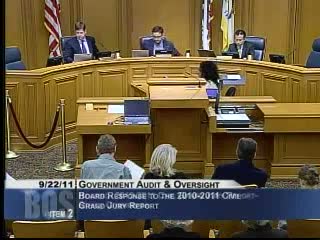
The Government Audit and Oversight Committee held a hearing on the 2010'2011 civil grand jury report titled "San Francisco Ethics Commission: The Sleeping Watchdog." The grand jury found repeated dismissals of Sunshine Ordinance Task Force referrals, questioned the commission's membership selection process and urged greater transparency, including televising meetings.
Brian Clement, who chaired the grand jury subcommittee, said the task force's referrals to the Ethics Commission between 2004 and 2010 were all dismissed for various reasons and recommended stronger public hearings, additional independent appointees to the commission and broadcasting its meetings.
Executive Director St. Croix (Ethics Commission) told the committee the commission disagrees with some findings but has already acted on several recommendations: formalizing criteria used to set fines, expediting Sunshine referrals, allowing a single commissioner to calendar items for full commission consideration, and endorsing televising hearings. The Mayor's Budget Office said several recommendations are reasonable but some require further analysis or voter approval.
Public commenters described long delays in Ethics Commission investigations of whistleblower complaints and alleged conflicts of interest. Dr. Maria Ribero said three complaints took years to progress; Dr. Derek Kerr said, "The sleeping watchdog moniker is appropriate," and recounted that an ethics complaint was referred to the district attorney and then stalled.
Deputy City Attorney Andrew Shen and Chief Assistant District Attorney David Pfeiffer said the Ethics Commission could change its regulations to begin investigations after the 14-day notification window if it wishes, and the DA's office said it has no objection to the commission proceeding after that period in general.
After discussion, the committee agreed with Findings 2 and 7 (timely Sunshine hearings and improving transparency by televising meetings), expressed caution about the specific charter-change proposal in Finding 4 and adopted amended language stating the Board "does not take a position on the specific recommendation" to change the charter but is open to considering options to reduce appearances of impropriety. Supervisors asked the commission and the Sunshine Task Force to coordinate a schedule to present more detailed data and to pursue televising options with SFGovTV.
Next steps: Committee staff will prepare the Board's formal response; the committee indicated willingness to introduce a resolution to require the Ethics Commission's meetings to be televised and to hold a follow-up hearing after the commission considers Sunshine Task Force comments in November.