Get Full Government Meeting Transcripts, Videos, & Alerts Forever!
Get email alerts on the Advertising Contracts topic
No spam. Unsubscribe anytime.
Audit finds inconsistent city advertising standards, flags low DPW revenue share with JCDecaux
Summary
A Budget and Legislative Analyst audit found uneven advertising standards across city departments, identified a Department of Public Works deal that remits about 7% of gross ad revenue to the city, and recommended centralizing standards and contract oversight to recover lost revenue.
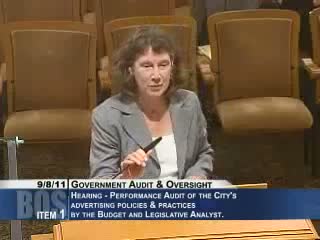
A city audit presented Sept. 8 found San Francisco’s advertising agreements vary widely in financial terms and content controls, costing the city potential revenue and leaving compliance uneven across departments.
The Budget and Legislative Analyst Office told the Board of Supervisors’ Government Audit and Oversight Committee that citywide advertising revenue totaled about $20.9 million in the audit year and that roughly two-thirds of that came from the Municipal Transportation Agency (MTA). The office completed the performance audit after a Board motion in November 2010 and transmitted the final report in April 2010. The reviewers made four findings and 15 recommendations, saying better central oversight could increase annual revenues by roughly $1.3 million.
The analysts said the Department of Public Works’ contract with JCDecaux — which installs public toilets and commercial kiosks — requires the company to remit only about 7 percent of gross advertising revenue to the city (in addition to a base payment). The report contrasted that share with the airport’s agreement with Clear Channel, which includes a minimum annual guarantee equal to about 70 percent of gross in some terms. "Most city advertising agreements require the company to remit the higher of a minimum annual guarantee or a percentage of gross revenues of at least 40 percent," the analysts wrote. "The DPW–JCDecaux agreement only requires 7 percent."
Analysts recommended DPW seek contract amendments and incentives to increase the city’s share; they estimated that raising DPW’s split to 25 percent, coupled with additional kiosks, could yield about $1.1 million more annually. Committee members asked staff to provide the full DPW–JCDecaux contract for review; analysts and DPW representatives said the agreement runs through 2016 and may not include an easy unilateral termination clause.
The audit also examined naming-rights arrangements at Candlestick Park and other department contracts. Analysts said the 49ers’ exclusive right to negotiate stadium naming rights requires the team to remit 50 percent of naming-rights revenue to the city, and that unused naming-rights authority has likely cost the city about $1 million per year in forgone revenue based on past experience.
Sarah Duffy and colleagues briefed the committee on MTA contracts: transit-shelter advertising with Clear Channel, vehicle and parking-garage advertising with Titan, and an MOU with BART for Muni–BART stations. The analysts noted significant recent gains in MTA advertising revenue (about $7.4 million over four years) but said Titan had not sold ads in five city-owned parking garages since 2009; they estimated MTA could capture roughly $250,000 a year from those locations if sold.
On compliance, auditors found inconsistent monitoring of maintenance obligations: graffiti and stickers on transit infrastructure, torn or missing ad cards on buses, news racks used for storage and trash, and at least two public toilets out of service for more than two weeks. The analysts recommended documented site inspections and stronger documentation of contractor compliance; they said all departments except MTA agreed or partially agreed with compliance recommendations.
SFMTA Chief Financial Officer Sonali Bose disputed some findings in public remarks to the committee, saying SFMTA has embedded advertising requirements in contracts, receives comprehensive monthly sales reports from contractors, conducts year-end audits (including verification by KPMG), and tracks shelter and maintenance activity through a contract website. Bose acknowledged resource limits for routine physical inspections but said MTA staff conduct random reviews and that many shelter removals resulted from community requests.
Committee Chair David Campos said the city administrator had agreed to coordinate and centralize uniform advertising standards and asked the committee to follow up with DPW on the JCDecaux terms. The committee opened the item to public comment; resident Douglas Yap urged more frequent audits and stronger fiscal oversight.
The committee moved Item 1 to the call of the chair after the presentation.
The audit’s primary recommendations were that the city administrator set uniform advertising standards, departments strengthen monitoring and compliance documentation, DPW pursue renegotiation of low-revenue contracts, and MTA improve oversight of unsold inventory and maintenance checks. The committee requested contracts and follow-up information from DPW and MTA and signaled interest in centralizing advertising standards across city departments.