Get Full Government Meeting Transcripts, Videos, & Alerts Forever!
Get email alerts on the Vision Zero topic
No spam. Unsubscribe anytime.
Supervisors advance Vision Zero resolutions, urge SFMTA to lower speeds and speed up quick‑build safety projects
Summary
The committee unanimously recommended two Vision Zero resolutions urging SFMTA to pursue lower posted speed limits where lawful, expand signal‑timing strategies, invest in quick‑build street safety improvements and identify a dedicated staff lead; SFMTA officials described data and an $25M quick‑build plan over five years.
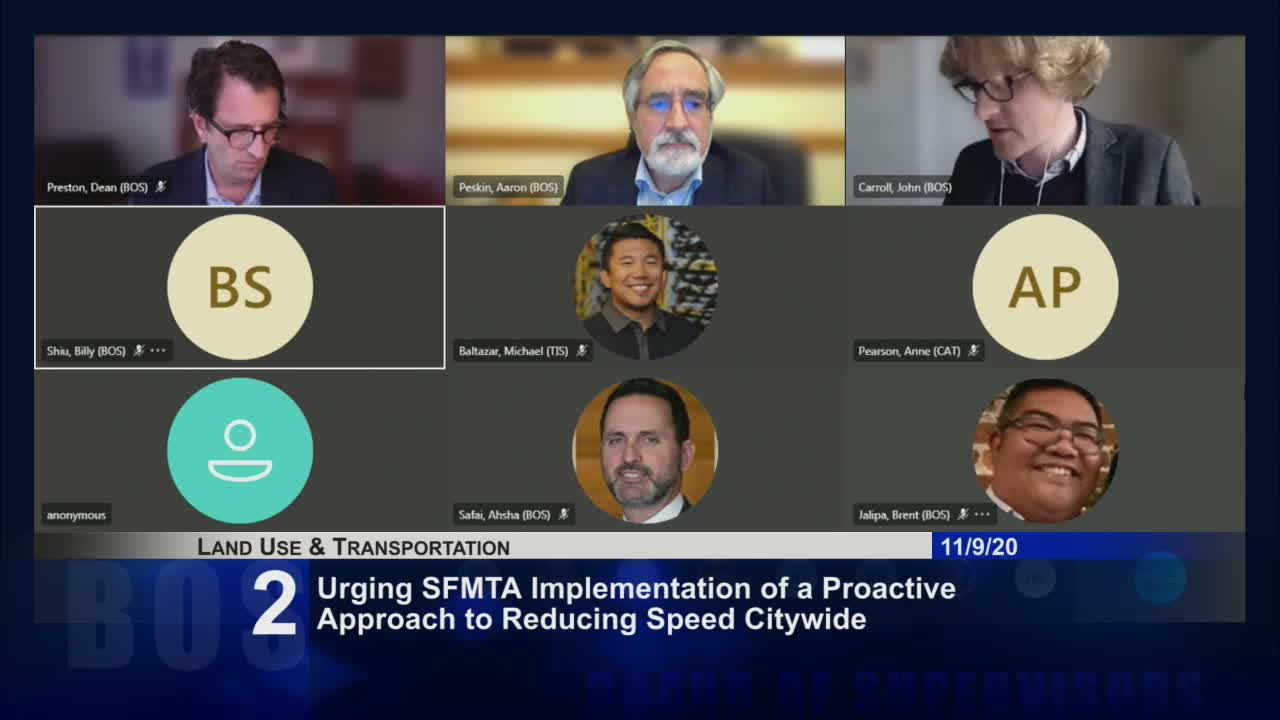
The Land Use and Transportation Committee on Nov. 9 advanced two resolutions aimed at reducing traffic fatalities and accelerating Vision Zero work citywide. Board President Norman Yee and SFMTA Vision 0 lead Ryan Reeves described the city’s safe‑systems approach and emphasized that slowing vehicle speeds is the most effective measure to reduce severe and fatal crashes.
Ryan Reeves said San Francisco had recorded 23 traffic fatalities through October, including nine pedestrians and two cyclists, and that 75% of severe and fatal injuries are concentrated on 13% of city streets—the high‑injury network. SFMTA outlined a mix of interventions: engineering changes (lane reductions, protected intersections, daylighting), signal timing (leading pedestrian intervals), protected bikeways, and a program of low‑cost quick‑build projects. Reeves said the quick‑build program represents over 15 miles of low‑cost improvements and that SFMTA plans about $25 million in quick‑build investment over five years; an estimated $85 million would be needed to complete corridor‑level quick‑build improvements across the high‑injury network.
During Q&A, President Yee and supervisors pressed staff on 'slow senior zones' and legal constraints. Ricardo Vallejo, the city traffic engineer, said the California Vehicle Code permits lowering posted speeds to 25 mph around certain senior facilities when the roadway’s posted limit exceeds 25 mph; SFMTA has identified roughly eight initial locations and expected sign installation by year‑end. Staff said they have retimed downtown corridors for 20‑mph progression and are expanding signal timing work where resources permit. SFMTA staff also said they are exploring a no‑turn‑on‑red policy in the Tenderloin and pursuing state and federal guidance for automated speed enforcement.
President Yee read text amendments to the recommitment resolution to emphasize an 'updated action strategy,' replace 'codify' with 'adopt and implement,' rename 'high injury corridors' to 'high‑injury network,' add 'daylighting' as an immediate intervention, and ask the mayor to designate a dedicated staff lead. The committee approved the amendments and sent both resolutions to the full Board with a positive recommendation (roll call recorded as 3 ayes).
What happens next: the resolutions will be transmitted to the full Board with recommendations and SFMTA agreed to provide lists and follow‑up reports on sites and timing for interventions.