Get Full Government Meeting Transcripts, Videos, & Alerts Forever!
Get email alerts on the Transportation Budget topic
No spam. Unsubscribe anytime.
SFMTA budget advances amid sharp debate over Sunday meter enforcement and meter upgrades
Summary
SFMTA presented a two‑year budget focused on maintenance, reliability and modernization, proposing meter upgrades, indexing of fares, a youth fare pilot and new parking policies including partial Sunday enforcement (noon start). Public commenters and several supervisors opposed Sunday meters; the committee asked for more outreach and technical adjustments before final action.
The San Francisco Municipal Transportation Agency told the Budget & Finance Committee on May 1 that its FY2012–14 budget emphasizes maintenance and reliability, with capital and operating proposals to modernize meters, invest in Muni maintenance staff, and pursue targeted parking‑management changes.
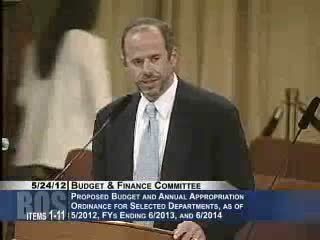
Ed Ryskin, SFMTA director of transportation, outlined the agency’s priorities: more than 100 maintenance hires to reduce unplanned service gaps, investment in the Transit Effectiveness Project, and a procurement to replace older meters with credit‑card‑capable devices and improved displays. He described three parking revenue changes in the adopted budget: (1) passing through new state citation surcharges (about $5 million/year), (2) adding limited Sunday meter enforcement (starting at noon with four‑hour limits) to manage demand in commercial areas, and (3) modest metered expansions to fill gaps in commercial corridors.
The proposed Sunday enforcement drew extensive public comment. Dozens of speakers — including faith leaders, church representatives and neighborhood advocates — urged delay or exemption, saying Sunday meters would disproportionately burden low‑income congregations and small businesses. "Sunday meter enforcement presents an undue hardship on inner‑city, lower‑income residents," said Curtis Bradford of Glide. Reverends Cecil Williams and Robert Lucas characterized the proposal as divisive and urged the board to reconsider.
Supervisor concern was broad and not limited to houses of worship: supervisors and SFMTA staff acknowledged merchant and neighborhood concerns about signage, language access and the ability to prepay meters. Ryskin said the policy intent is to improve parking availability in busy commercial areas and to align parking management with transit‑first goals; the agency proposed an implementation working group with stakeholders and said meters would allow prepayment so customers could pay before noon if needed.
The budget also includes policy changes for fares: an indexing policy for passes (for example, the adult FastPass rising from $62 to $64 then $66 in subsequent years) and an expansion of fare inspection staffing (about 10 additional fare inspectors, ~ $900,000) to support all‑door boarding and improve fare compliance.
The committee accepted SFMTA’s transmitted budget materials/assumptions but directed SFMTA to continue consultations and to return with technical amendments as labor negotiations and revenue updates evolve. Supervisors emphasized that if Sunday enforcement proceeds, meter modernization, clear multilingual signage and robust outreach must precede implementation.
Why it matters: The SFMTA budget creates immediate investment to improve Muni reliability and long‑term capital projects, but the parking management proposals (especially Sunday enforcement) have significant neighborhood equity and political implications.
What happens next: The committee continued enterprise items into June budget deliberations to allow time for MTA technical adjustments, further stakeholder outreach on Sunday enforcement and finalization of meter procurement timing.