Get Full Government Meeting Transcripts, Videos, & Alerts Forever!
Get email alerts on the Municipal Debt topic
No spam. Unsubscribe anytime.
Supervisors probe $1.36 billion in non‑voter debt; certificates of participation draw scrutiny
Summary
A broad hearing examined San Francisco's nonvoter approved debt, with the Comptroller and Budget & Legislative Analyst presenting portfolio data and comparators and the City Attorney explaining COP legal structure; supervisors asked for further analysis and continued the item to the call of the chair.
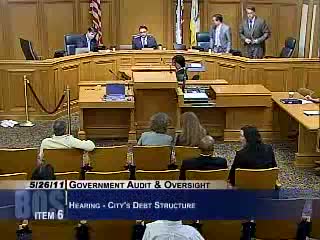
Supervisor Mark Farrell opened a committee hearing focused on the city's nonvoter approved debt, the use of certificates of participation (COPs), and the broader debt portfolio. Farrell said he had been quoting a $1.36 billion figure and clarified that public messaging had sometimes mixed principal and interest figures.
Nadia Sissay (Comptroller's Office of Public Finance) gave an overview of the city's debt portfolio as of May 2011, citing roughly $2.6 billion in outstanding obligations across instruments: about $1.4 billion in general obligation bonds, $264 million in lease‑revenue bonds, $742 million in certificates of participation, $110 million in San Francisco Redevelopment Agency items, and $6 million in parking authority lease revenue bonds. Sissay said COPs in the portfolio included self‑supporting transactions (e.g., 525 Golden Gate), and that true general‑fund COP obligations were a smaller subset.
City Attorney Mark Blake reviewed COP structure and legal background: COPs are structured so that lease obligations are contingent and have been judicially upheld as exceptions to the state constitutional debt limit (Article XVI, Section 18). He explained that COPs are often validated via a judicial validation process or reverse validation and stressed the need for disclosure and diligence to ensure public purpose and tax‑exempt treatment.
Katie Solinski and Severin Campbell (Budget & Legislative Analyst) presented a comparative analysis of 15 large California jurisdictions and concluded San Francisco was the only jurisdiction that requires voter approval for lease‑revenue bonds; as a result, COPs are the city's primary nonvoter vehicle. The analysts reported San Francisco's COP debt supported by the general fund was among the highest on a per‑capita basis (the transcript reported about $735 per capita for COPs alone as of 06/30/2010) and acknowledged earlier errors in a spreadsheet that they said they would correct.
Supervisors, the mayor's budget office and the Comptroller discussed how COPs compare with voter‑approved lease‑revenue bonds in pricing (roughly 40–65 basis points differential noted), timing advantages of COPs, and policy choices for large capital needs such as a seismically deficient Hall of Justice. Public commenters called for more transparency and argued COPs can look like an end‑run around voter approval. The committee voted to continue the item to the call of the chair to allow follow up analyses on ratios (per‑capita and property valuation), sources of COP issuance, and a revised comparison of principal and interest.