Get Full Government Meeting Transcripts, Videos, & Alerts Forever!
Get email alerts on the Wage Theft topic
No spam. Unsubscribe anytime.
Oversight hearing spotlights wage theft as wide-ranging enforcement challenge; agencies pledge coordination and resources
Summary
Supervisors held an extensive hearing on wage theft that featured worker testimony, a presentation by the Office of Labor Standards Enforcement (OLSE) on its investigative model and recoveries, a Budget Analyst comparison with state procedures, legal advocates' critiques of delays, and commitments from the District Attorney, Police and Health Department to coordinate enforcement. The committee asked for follow-up, interagency collaboration and possible legislative changes to speed remedies.
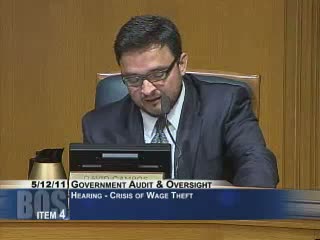
The Committee held a full hearing on wage theft enforcement, bringing together community witnesses, the Office of Labor Standards Enforcement (OLSE), the Budget/Legislative Analyst, legal aid clinics, the District Attorney's Office, the Department of Public Health, the Police Department and the Treasurer's Office. Chair David Campos framed wage theft as a systemic problem affecting low-wage and immigrant workers and said the hearing should be the start of stronger city action.
Donna Levitt, director of OLSE, described the city's enforcement model: OLSE audits payroll records, conducts site visits, preserves claimant confidentiality, pursues individual owner liability and reaches settlements or hearings. She said OLSE has recovered about $4.0 million for 2,601 employees across roughly 3,317 cases and partners with community organizations to reach claimants. Levitt also acknowledged resource constraints: OLSE assigns portions of six staff members to minimum-wage cases and has unfilled positions that limit hearing capacity.
Dan Goncher of the Budget/Legislative Analyst's Office reported that while OLSE secures a higher collection rate than the state for amounts assessed, its process is lengthier for cases that go to hearing; he recommended adding management timelines, default-judgment authority based on OLSE determinations, improved reporting and stronger posting requirements to encourage employer compliance.
Legal advocates and clinicians praised OLSE's approach but documented cases where lengthy delays (one example took more than four years to reach hearing) meant workers still had not received court-ordered payments. Advocates urged more staff, an OLSE-dedicated city attorney unit, better case tracking and options to allow private counsel to represent workers in hearings to speed remedies.
City agencies outlined complementary roles: Rajeev Bhatia (Department of Public Health) described using permitting and inspection authorities to flag and refer labor-law violations and in some cases suspend permits until wage violations are remedied; Christine Duberry (District Attorney's Office) said the DA will prosecute criminal wage-theft where appropriate and wants closer coordination on referrals; Sgt. Arlen Vanderbilt (SFPD) described human-trafficking protocols that overlap with wage-theft investigations; Greg Cotto (Treasurer) outlined a collections MOU to help OLSE secure unpaid judgments. Community organizations and dozens of workers gave personal testimony about unpaid wages, retaliation and language-access barriers; speakers called for stronger penalties, faster hearings and more multilingual outreach.
Supervisor Eric Mar and others proposed forming a task force and increasing resources for enforcement; the committee moved to continue the item for follow-up, and members asked staff to draft possible legislative changes to tighten timelines, shift evidentiary burdens in some circumstances, and enhance interagency coordination.