Get Full Government Meeting Transcripts, Videos, & Alerts Forever!
Get email alerts on the Laguna Honda Gift Fund Audit topic
No spam. Unsubscribe anytime.
Audit finds coding and record‑keeping failures at Laguna Honda gift fund; health department and commission promise policy changes and refunds
Summary
The City Services Auditor’s compliance audit found misclassified donations, missing supporting documents and a FY2007 $176,000 reclassification later reversed; auditors recommended returning approximately $818,000 (plus $127,700 already returned) to patient accounts and stronger policies. Public commenters and whistleblowers said patient services were cut and alleged misappropriation of about $350,000; the Health Commission and DPH acknowledged errors and adopted new procedures.
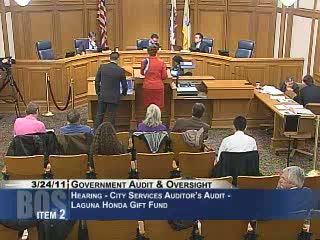
The Board of Supervisors Government Audit and Oversight Committee heard a detailed compliance audit of the Laguna Honda Hospital patient gift fund on March 24, 2011. The audit, conducted by the City Services Auditor (CSA) in the Controller’s Office, covered donations and expenditures from November 1, 2004, through June 30, 2010, and used a statistical sample (95% confidence level) that yielded 324 tested transactions.
Tanya Lettichu of the Controller’s Office said the audit examined 22 subaccounts (17 patient‑related, 4 staff‑related and one earned interest holding account) and found that the overall fund balance declined from about $2,150,000 to $1,720,000 over the audit period (a decline of approximately $430,000, or about $72,000 per year). Annual donations averaged about $115,000 during the period, with a notable drop of roughly $75,000 in fiscal years 2008–09 attributed to the economic climate.
The audit identified two broad problem areas: donation/expenditure coding errors and record‑keeping gaps. Auditors reported that donations intended for patients were sometimes recorded to staff‑development subaccounts because receipt tags were coded incorrectly; the audit team tested all 50 recorded transactions into staff accounts totaling $192,483 and found $37,319 (19%) were correctly recorded as staff donations while $151,739 (79%) were coded to staff accounts but lacked documentation of donor intent. Laguna Honda corrected $827,000 of earlier misallocations before and during the audit and the audit recommended an additional return of $818,000 plus the earlier $127,700 returned by Laguna Honda. Auditors also cited that 35% of the sample expenditures (112 of 324) lacked supporting documentation in‑house although many descriptions could be found in the city accounting system (FAMIS); the office attributed missing paper records to staff turnover and fulfillment of numerous public‑records requests.
The report noted a journal entry of about $176,000 in fiscal 2007 that was used to clear a capital‑project deficit and was later reversed when the issue was identified; auditors recommended Laguna Honda calculate and credit any interest the patient fund lost while the amount was out of the principal. The audit also found that internal policy changes over time effectively removed the Administrative Code requirement that Health Commission approve all gift‑fund expenditures, which auditors said increased the perception of misuse. The Controller’s Office recommended that Laguna Honda work with the Health Commission to adopt a complete gift fund policy, separate staff development from patient funds, work with the Treasurer and Tax Collector on active investment management, and develop controls to ensure expenditures conform to policy.
Sonia Melara, vice president of the San Francisco Health Commission, told the committee the commission accepted new policies on March 1, removed staff accounts from the patient gift fund and will receive quarterly reports; she said a council including patients and staff will review decisions and quarterly reporting will provide oversight. Greg Sass, the Department of Public Health finance officer, acknowledged accounting errors, said many adjustments were identified and corrected during the June 30, 2010 close, and stated an initial year‑end instruction that produced the $176,000 reclassification originated in a year‑end adjustment noted in controller office notations and was later corrected.
Several members of the public — including former Laguna Honda employees who identified themselves as whistleblowers — gave strongly worded testimony. Dr. Maria Rivera and Dr. Derek Kerr said patient programs were curtailed while staff events continued and alleged a total refund of about $350,000 was required to return patient‑designated funds. Rivera said she had resigned in protest and objected to use of public funds for outside contracting on a transition project; Kerr described workplace retaliation against whistleblowers. The Controller’s Office and the Department of Public Health disagreed with some characterizations but acknowledged the need for stronger controls and transparency.
Controller staff emphasized that the audit conclusions apply to the tested statistical sample and cannot guarantee there are no other untested irregularities outside the sample; Alyssa Sullivan (Controller’s Office) told the committee the office could only speak to the selected sample with the stated confidence level. Committee chair David Campos and supervisors pressed for a mechanism to track implementation of audit recommendations across the universe of audits; Controller Rosenfield agreed to work with the chair to produce a comprehensive report and the committee continued the item to the call of the chair to monitor implementation and corrective steps.
The audit cites the San Francisco Administrative Code and the CSA recommended gift‑fund policy changes, return of misallocated funds and procedural reforms; the Health Commission and Department of Public Health committed to quarterly reporting and new internal controls. The committee will reconvene the matter to review implementation progress.