Get Full Government Meeting Transcripts, Videos, & Alerts Forever!
Get email alerts on the Overtime Budget topic
No spam. Unsubscribe anytime.
Supervisors press city departments on $40 million overtime overrun; MTA and fire face closest scrutiny
Summary
At an April 14 hearing, the City and County of San Francisco's audit committee heard that citywide overtime is projected about $40 million over budget for FY2010-11; supervisors pressed departments on staffing, exemptions and budgeting and agreed to continue the item for follow-up, including a detailed MTA presentation.
San Francisco ' At a Government Audit and Oversight Committee hearing April 14, deputies from the Controller's Office and department finance and human-resources officials told supervisors the city now projects roughly $40,000,000 in overtime spending above what was budgeted for FY2010-11.
Deputy Controller Monique Zamuda said the figure is a straight-line projection based on about seven months of payroll data and that the five departments that account for most overtime are the Municipal Transportation Agency, Fire Department, Police Department, Department of Public Health and the Sheriff's Department. "These projections should be used only as a starting point," Zamuda said, and the controller will continue to produce monthly and biannual overtime reports.
The committee focused on two trouble spots. Terry Williams, deputy chief financial officer for the MTA, said about 91 percent of the agency's overtime is in transit operations and is concentrated in drivers and maintenance; service restorations, special events and earlier cuts in maintenance positions contributed to a spike in overtime. "We need more operators on the road," Williams said, and the agency agreed to return with a full presentation explaining recent trends.
Fire Chief Joanne Hayes White told supervisors the department's overtime rose as FTE head counts fell from 1,772 in 2005/06 to about 1,403 in the current year. Chief Hayes White said a combination of minimum staffing requirements (300 personnel citywide per 24-hour shift, tied to NFPA apparatus standards) and the cost of pension and benefits have made hiring additional full-time firefighters more expensive in some analyses than covering shifts with overtime. "Our overtime would drop significantly," she said, "but you'd see an increase in regular salaries and, over a 20- or 30-year projection, much higher pension and benefit costs."
Human Resources Director Nikki Callahan described the department's four criteria for granting exemptions from the Administrative Code's individual overtime cap (Administrative Code Section 18.13): mandatory overtime with no qualified employees under the cap available, complex ongoing investigations (for example a homicide investigator), mandatory training that cannot be scheduled during regular hours, and certain coding practices for part-time employees. Zamuda said 74 employees exceeded the statutory cap for the pay period ending Jan. 7; 70 had exemptions, three were deputy sheriffs/institutional police with exemptions under review, and one was a clerical oversight.
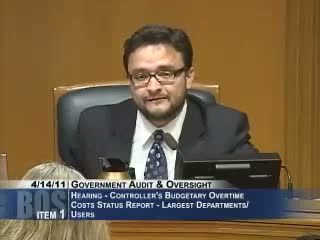
Supervisors signaled interest in policy changes. Chair David Campos proposed forming a citywide working group focused on overtime and realistic budgeting; several supervisors pressed staff to analyze whether making overtime its own budget category or reducing the individual cap would be feasible. Supervisor Mark Farrell moved to continue the item to the call of the chair for follow-up, and the committee agreed without objection.
What's next: the committee asked for detailed MTA presentation materials, a human-resources analysis of exemption criteria and a joint report from DHR and the controller's office explaining the relationship between staffing levels, overtime and long-term pension costs. The committee also directed departments to provide the controller's March report and relevant workforce analyses to supervisors.
(Committee action: Supervisor Mark Farrell moved to continue Item 1 to the call of the chair; the motion carried without objection.)