Get Full Government Meeting Transcripts, Videos, & Alerts Forever!
Get email alerts on the Human Resources topic
No spam. Unsubscribe anytime.
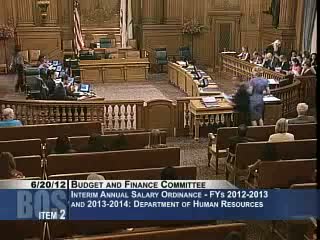
Human Resources director outlines hiring, workers'comp trends and PeopleSoft rollout
Summary
Human Resources Director Micki Callahan told the Budget & Finance Committee that DHR agreed with the analyst's recommendations after correcting a small FTE error and described three budget drivers: labor negotiations, a rising workers'comp bill and expansion of the City Hall Fellows program. She said PeopleSoft (eMERGE) and examination streamlining should speed hiring.
Micki Callahan, director of the Department of Human Resources, told the Budget and Finance Committee that DHR had reached agreement with the Mayor's Budget Office and the Board's analysts on most recommendations after identifying a small technical error in its FTE count. Callahan said the department's original submission had reported an increase of 3.71 positions; the correct net increase is 0.71, reflecting shared workers' compensation administration for the MTA.
Callahan identified three main areas driving this department's budget work. First, an unusually large set of labor negotiations during the prior cycle raised one'time costs for attorneys and arbitration; she said those negotiations have concluded and the coming year will be a relative "down year" for labor-relations spending, though some staffing must be preserved to meet ongoing obligations created by recently approved agreements.
Second, workers' compensation remains a major line item. Callahan told supervisors the city spends about $45 million a year on claims and benefits and that costs are beginning to edge upward largely due to higher medical costs and some legislative presumptions that increase public-safety claims. She described internal reforms ' faster electronic processing, a medical-provider network and shorter turnaround on settlement approvals ' that have kept costs lower than many peers. The department anticipates coming in about $2.5 million below its workers' compensation budget for the year then ending.
Third, Callahan described a modest increase to support the City Hall Fellows program (from 11 to 14 fellows) and an internal effort to streamline hiring processes. She said DHR is leading work with the Controller on a PeopleSoft 9 rollout ("eMERGE") and adopting core examinations that will let departments adapt rather than build full, job-by-job tests. Callahan and Ted Yamasaki (DHR) said classification and eligibility work for departments such as Emergency Management will take about six months to complete.
Budget analyst Harvey Rose reported recommended reductions for DHR totaling about $115,006 for 2012-13, largely ongoing savings, and said the department concurred with the recommendations. Chair Carmen Chu said the committee would tentatively accept the analyst's recommendation pending public comment.