Get Full Government Meeting Transcripts, Videos, & Alerts Forever!
Get email alerts on the Sfpuc Audits topic
No spam. Unsubscribe anytime.
Controller's audits find lease, inventory and royalty problems at SFPUC; agency pledges reforms
Summary
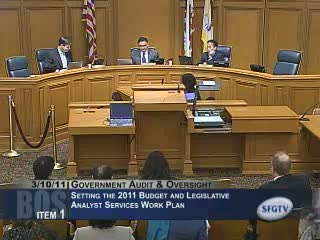
A Controller—s Office presentation to the Government Audit and Oversight Committee on March 10 summarized six audits of the San Francisco Public Utilities Commission that found lease-management deficiencies, uncollected charges, obsolete inventory and potential underpayments by a quarry operator; the SFPUC committed to staffing changes, system upgrades and six-month follow-up reporting.
The Controller—s Office presented six performance audits of the San Francisco Public Utilities Commission (SFPUC) on March 10, finding a pattern of lease-management weaknesses, billing and inventory shortcomings, and recoverable or potentially recoverable revenue shortfalls.
Tanya Lettigy, director of audits in the Controller—s Office, told the committee the audits covered FY 2009—10 and 2010—11 and included compliance and management reviews as well as construction project audits. On two golf-course leases auditors found Sunol paid $1,000,000 and Crystal Springs $2,900,000 in rent but SFPUC did not assess late charges totaling $77,320 and the lessees had not always submitted required quarterly gross-revenue statements or timely CPA reports.
The Controller—s Office flagged broader fixed-rent lease problems: three tenants lacked required insurance coverage, SFPUC did not collect full security deposits for 11 of 14 leases (totaling $118,590), and staff sometimes waived late-payment penalties that the leases required. The auditors recommended improving verification of insurance, collecting required deposits and modifying billing systems to assess penalties when due dates vary.
The wastewater inventory audit found the Southeast and Oceanside plants held $3,600,000 in inventory at June 2009, of which substantial portions had not been used for five years (approximately $468,000 at Southeast and $113,000 at Oceanside). Auditors recommended fuller use of Maximo, handheld scanners, and periodic inventory review to reduce carrying costs and risk of obsolete stock.
On the Mission Valley rock leases (Hansen), auditors reported the SFPUC had collected $6,800,000 during the audit period but identified immediate recoveries of $154,904 and potential additional recoveries. Auditors estimated underpayments and other recoverable amounts up to $634,000 and identified about $2,000,000 in lost revenues that were unlikely to be collectible under current lease treatment; the office said some issues require further city-attorney review.
A construction audit found generally strong contract management on the Tesla water treatment facility (an $81.4 million design-build contract) and the East West Transmission Main (about $23.2 million), though auditors noted CMIS reporting and integration with the city—s FAMIS accounting system could improve; the East West project included change orders that increased payments by roughly $3.2 million (about 16% of the original contract phase referenced).
"Overall, CSA has found that the PUC facilitates the audit process quite well, is receptive to the audit findings, and that, in general, the PUC views the audit findings as opportunities for improvement," Lettigy said.
Todd Rechstrom, assistant general manager for the SFPUC, acknowledged the problems identified and described management steps already taken: a proposed real-estate reorganization, staff training and interim tracking (Excel) while Maximo upgrades were implemented, an insurance tracking system, and monthly oversight meetings with the Controller—s Office. "We are very, very serious with all of our follow-up findings," Rechstrom said, and the PUC agreed to report progress to the committee and commission.
Committee members agreed to ask the Controller—s Office and the SFPUC to return with status reports; the Controller—s Office noted standard follow-up points at 6, 12 and 24 months and the committee suggested a six-month progress briefing. The committee then moved, without objection, to continue Item 2 to the call of the chair so the agencies can coordinate a return date.