Get Full Government Meeting Transcripts, Videos, & Alerts Forever!
Get email alerts on the Open Data topic
No spam. Unsubscribe anytime.
Committee advances open-data ordinance establishing DataSF, accepts privacy and licensing amendments
Summary
The committee advanced an ordinance to codify an open data policy and the DataSF portal, accepted amendments emphasizing consistency with privacy laws and COIT technical standards, and moved the ordinance to the full Board.
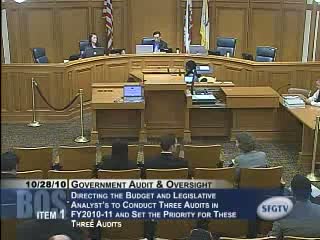
The San Francisco Government Audits & Oversight Committee on Oct. 28 advanced an ordinance to amend the San Francisco Administrative Code and formalize the city's open data policy, institutionalizing the DataSF portal and requiring departments to make appropriate datasets publicly available in machine-readable formats.
Jason Elliott of the Mayor's Office read proposed amendments into the record that require departments to make datasets available subject to Committee on Information Technology (COIT) rules and applicable law, to account for public datasets under departmental control in data plans, and for COIT to evaluate the feasibility of a generic license for city datasets. "Each City Department, Board, Commission, and Agency shall make reasonable efforts to make available datasets under the Department's control, provided, however, that such disclosure shall be consistent with the rules and standards promulgated by the Committee on Information Technology and with applicable law, including laws related to privacy," Elliott read into the record.
Jay Nath of the Department of Technology described DataSF and explained the rationale for machine-readable, structured data: "Open data is structured data. It's spreadsheets. It's a tabular form. It's not PDFs. It's not Word documents. And because of that, it's machine readable." Nath said DataSF already lists 182 datasets, includes participation from 27 departments and has supported over 50 applications built by third parties. He emphasized that releases would comply with federal, state and local privacy and security laws and described a three-tier review involving the data owner, the city attorney, and DataSF administrators before publication.
Committee members pressed on privacy; Nath said Section 2A of the ordinance makes eligibility subject to existing law and described the three-layer review process to prevent accidental release of private information. Members also commended practical examples such as transit and neighborhood apps.
Public commenters supported the ordinance. Tasneem Raja (Bay Citizen) said a central, proactive data repository would reduce time-consuming public-record requests and enable journalists to build tools and visualizations; Jose Lopez (web application developer) and Andreas Weigand (academic) also urged broader civic use. Craig Newmark (Craigslist) described open-government work at federal and other levels and voiced support for local efforts.
The committee accepted two non-substantive amendments without objection and moved the ordinance forward 'positively' to the Board of Supervisors for further consideration. No roll-call vote was recorded on the committee transcript. COIT and the Department of Technology were identified on the record as implementation leads.