Get Full Government Meeting Transcripts, Videos, & Alerts Forever!
Get email alerts on the Bicycle Plan Grand Jury topic
No spam. Unsubscribe anytime.
Board committee reviews civil grand jury's bike plan report; departments agree on education but split on immediate plan amendments
Summary
The committee heard the February 2010 civil grand jury report "Sharing the Roadway," discussed education, enforcement and equity recommendations for San Francisco's bike plan, and adopted a set of departmental responses while declining to amend the plan immediately because of cost and environmental‑review concerns.
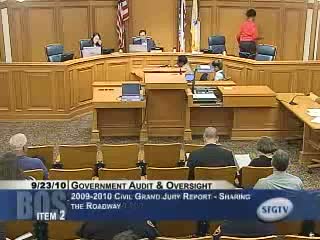
The Government Audit and Oversight Committee on Sept. 23 heard the civil grand jury—s February 2010 report "Sharing the Roadway: From Confrontation to Conversation," a review of safety, enforcement and equity issues affecting implementation of the San Francisco Bicycle Plan.
Leslie Kelch, foreperson of the civil grand jury, told the committee the report focuses on education, enforcement and fairness and urges the city to encourage residents to "share the roadway" through better outreach and by increasing police enforcement where appropriate. "The jury reviewed the San Francisco bicycle plan and focused on the issues of education, enforcement, and equity," Kelch said.
Jim Nadell, co‑chair of the jury panel, highlighted uneven enforcement in city courts and traffic data: "In the year 2009, 204,673 moving violation tickets were issued. And of that number, 1,968, less than 1% were issued to cyclists," he said, and recommended an education campaign, updated police training, and consideration of diversion or bicycle traffic court options.
City and public stakeholders debated whether to amend the recently adopted bicycle plan or address the grand jury—s recommendations through action plans and better interagency coordination. Manish Goyal of the mayor—s office said the mayor—s office "disagrees with any alteration to the bicycle plan" but supports improved education and enforcement. Bridgette Smith of the San Francisco Municipal Transportation Agency told the committee amending the plan now would likely trigger a substantial environmental review and could delay project delivery; she recommended targeted action plans or addressing issues in the next scheduled plan.
Committee members repeatedly supported updates to police training materials and better data collection of bicycle citations, asking SFPD to pursue Police Academy referral and to work toward entering all bicycle citations into the department database by Jan. 1, 2011. On registration, staff and jurors noted a state limit on local bicycle registration fees ($12 for a three‑year license) and said local registration would be difficult to administer in a city with large numbers of visitors and rental bicycles.
Public speakers, including members of the San Francisco Bicycle Coalition and the Bicycle Advisory Committee, generally supported the grand jury—s emphasis on education and consistent enforcement but warned against "one‑size‑fits‑all" approaches that treat typical cycling behavior the same way as motor vehicle violations. The committee adopted a series of responses — often "without objection" — accepting or partially accepting department responses while directing follow‑up and further analysis on several items.
The committee closed the hearing after agreeing to adopt the mayor and SFPD responses in multiple instances, refer police training updates to the Police Academy, request additional data from SFPD on citations and collisions, and to return with more refined implementation language as needed.