Get Full Government Meeting Transcripts, Videos, & Alerts Forever!
Get email alerts on the Tenant Protections topic
No spam. Unsubscribe anytime.
Committee advances emergency ordinance limiting construction that leaves tenants without water or power without alternatives
Summary
After extensive public comment from tenants and industry, the committee placed proposed amendments into the record and voted 3–0 to send an emergency ordinance to the full Board that would require property owners to provide alternative water or power (sufficient to power Internet) for residential tenants when construction requires shutting utilities, set notice thresholds, and create DBI enforcement with warning and subsequent citations.
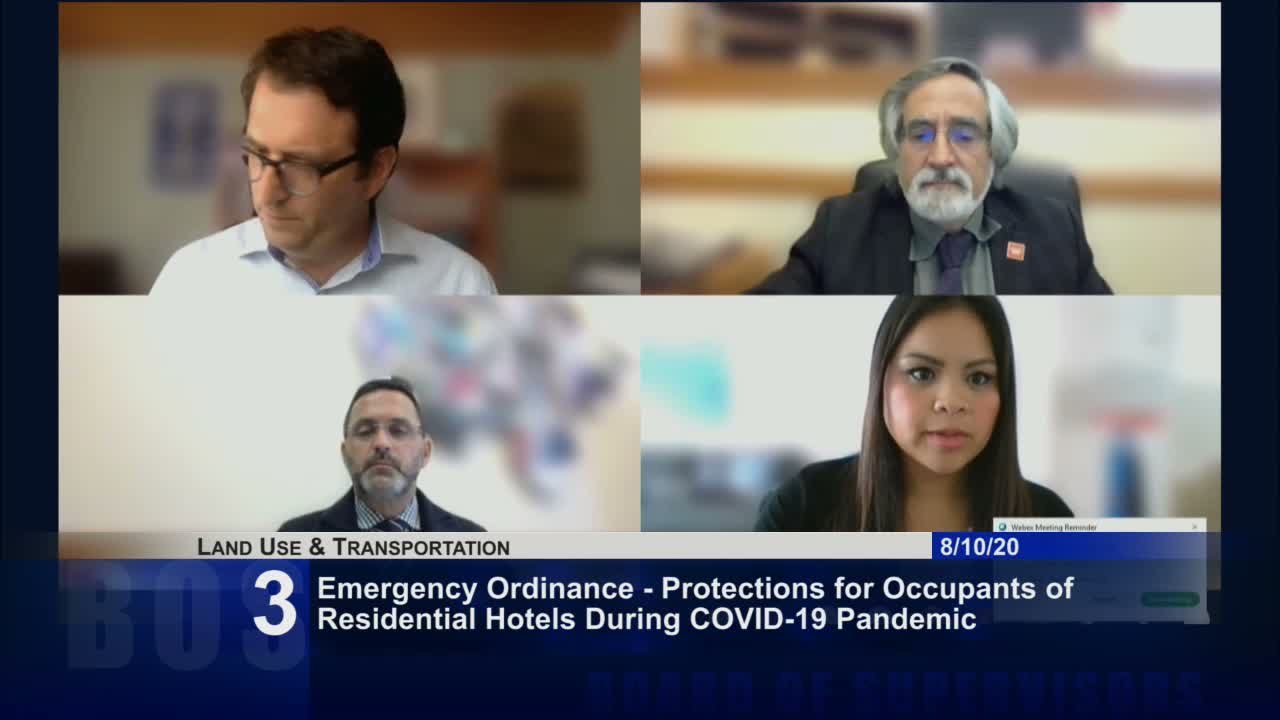
The Land Use and Transportation Committee advanced an emergency ordinance Aug. 10 intended to protect tenants during the COVID‑19 pandemic by temporarily prohibiting construction projects in residential buildings that require suspending water or electricity service to tenants unless alternative resources are provided.
Chair Supervisor Aaron Peskin outlined amendments that would exempt affordable housing meeting specific affordability and term conditions, require alternative water (for example, bottled water) and, for electricity outages exceeding the threshold, an alternative power source that "allows Internet use," set notice standards (72 hours for an anticipated interruption longer than two hours, one week notice for repeated interruptions), require insulation where loud equipment will be used, and direct DBI to issue a warning on a first violation and a notice of violation thereafter.
Vice Chair Safaei and other supervisors pressed for clarity on how the ordinance would treat routine maintenance and emergency repairs; Peskin said the measure is intended to target bad actors and is complaint‑driven and that immediate safety hazards would remain exceptions. Several tenants testified about drilling, noise, lack of notice, alleged harassment by owners (Veritas/GreenTree cited), and instances of workers not wearing masks; a tenant described repeated water and power shutoffs that forced them to seek neighbors' assistance for hygiene. Industry representatives including the San Francisco Apartment Association urged exemptions for code‑mandated work and warned that providing large‑scale alternative power could be impractical and noisy.
After public comment the committee voted to place the amendments into the record and to forward the item as a committee report to the Board of Supervisors for its Aug. 18 meeting; roll calls were unanimous (Preston, Safaei, Peskin). The committee also noted it will continue discussions to refine language on exemptions and implementation timing.