Get Full Government Meeting Transcripts, Videos, & Alerts Forever!
Get email alerts on the Treatment On Demand topic
No spam. Unsubscribe anytime.
Supervisors and providers fault Prop T report as late and insufficient; coalition urges comprehensive gaps analysis and more treatment and housing
Summary
Supervisors criticized the Proposition T (treatment-on-demand) annual report as late and inadequate; DPH defended timeliness issues and presented managed-care metrics while adult probation and community providers showed longer referral waits and urged a comprehensive, population-level gaps analysis tied to budget priorities.
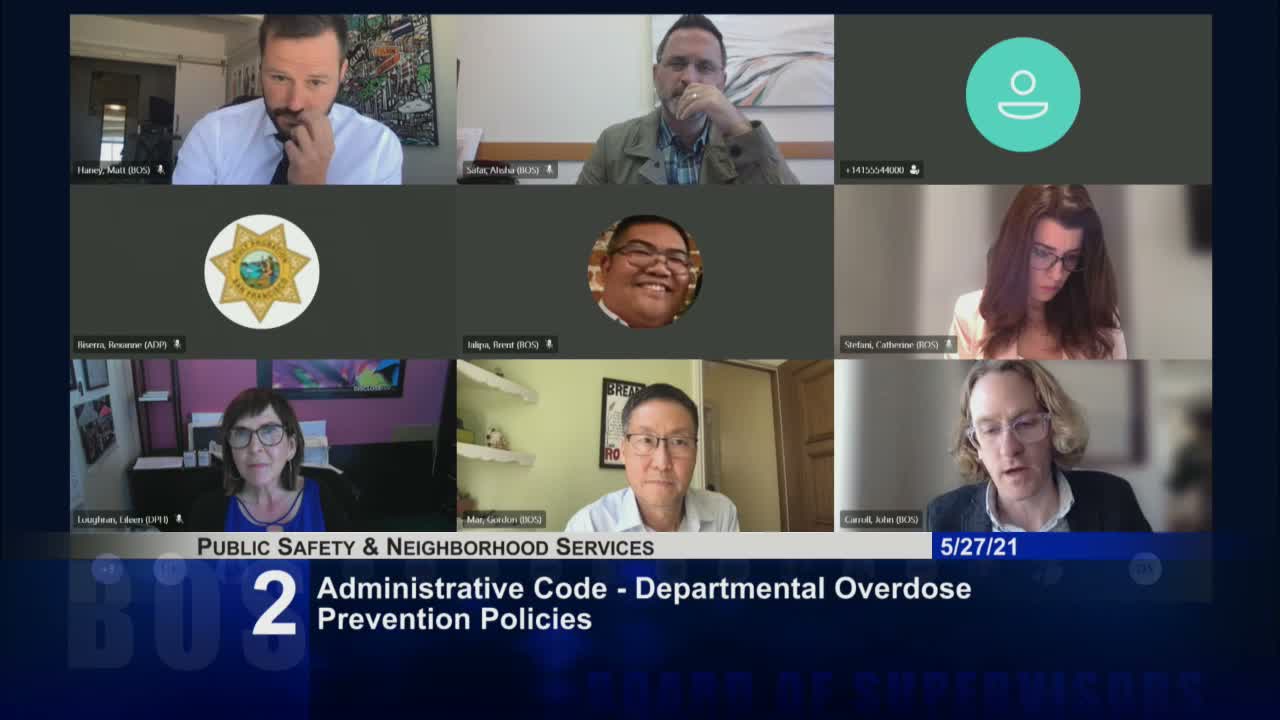
At a lengthy hearing on May 27, the Public Safety & Neighborhood Services Committee examined the Department of Public Health's Proposition T (treatment-on-demand) annual report and the broader system of substance-use treatment and recovery services in San Francisco. Committee sponsor Supervisor Rafael Mandelmann and others said the report, delivered to the committee the night before the hearing, failed to provide a usable gaps analysis for budgeting and planning.
Mandelmann reviewed the Prop T statutory language and said the report should measure the demand for treatment slots and provide a plan that informs city budgets. "The annual Prop T reports we reviewed at that 2019 hearing were notably thin documents that painted a picture that was radically different from the experience of treatment providers," he said, arguing the report had not been useful to providers, advocates or supervisors.
DPH's addiction psychiatrist and project lead, Dr. David Pating, explained the department's approach under the contemporary managed-care environment. DPH presented 2020 data showing timely same-day access for opioid treatment and perinatal programs and said residential treatment averages a five- to six-day wait with 95% of people admitted within 10 days. Pating flagged gaps in Spanish-language programs, outpatient services and transitional (step-down) residential beds and said DPH planned to expand low-threshold outreach (telebuprenorphine, a drug sobering center, expanded naloxone distribution and contingency-management pilots).
Adult Probation officials contradicted some of the report's timeliness claims. Victoria Westbrook (Adult Probation) said referrals from probation to contracted treatment took, on average, 41 to 49 days in recent fiscal years and that only 15 of 88 enrollees had completed treatment in the most recent period she cited. She said that for justice-involved clients the Prop T report's 1-to-8-day admission window did not match probation's referral experience.
Speakers from community providers and the Treatment on Demand coalition urged a comprehensive inventory and evaluation of services that centers voices of people with lived experience. Laura Thomas (Treatment on Demand coalition) said the system must address structural barriers including housing, language access, coordination of transitions between programs, and avoidance of overreliance on policing as a response to overdose.
Public comment included a range of providers, advocates and residents who highlighted barriers to treatment, the importance of supportive housing after treatment, cultural competency and systemic racial disparities. Adult probation and community providers asked that future Prop T reporting include subpopulation breakdowns (justice-involved, perinatal, language access), points where potential clients are lost during referral, and longitudinal outcomes post-treatment.
The committee agreed to continue the hearing to the call of the chair and to pursue follow-up meetings among DPH, the Treatment on Demand coalition, adult probation and other stakeholders to redesign the reporting so it becomes a practical gaps analysis that can inform budget decisions.