Get Full Government Meeting Transcripts, Videos, & Alerts Forever!
Get email alerts on the Anti Asian Violence Hearing topic
No spam. Unsubscribe anytime.
San Francisco hearing on anti‑AAPI violence: agencies, advocates call for coordinated plan and expanded victim services
Summary
A multi‑agency hearing on April 8 brought community groups and city departments together to catalogue rising anti‑Asian incidents and gaps in services. Community coalitions urged a rapid‑response victims network and funding; the DA requested dedicated city funding for a 24/7 victim hotline, more bilingual advocates and an emergency victim fund.
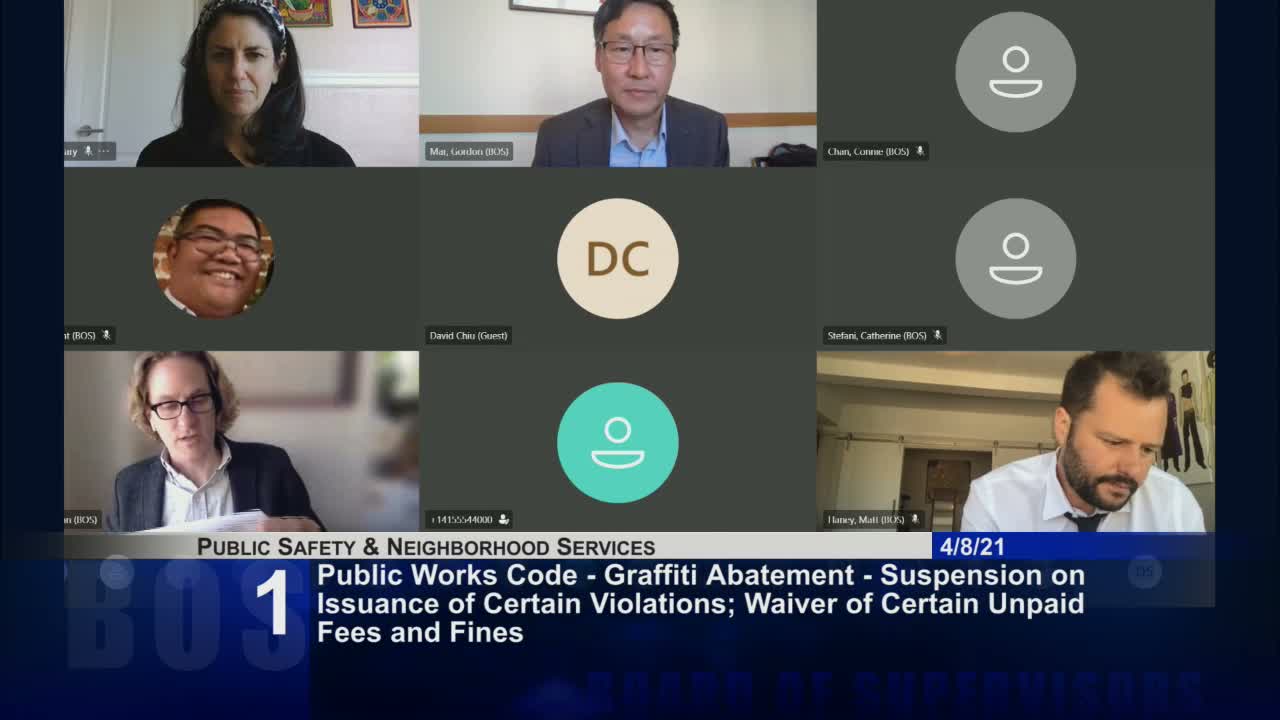
The Public Safety and Neighborhood Services Committee convened a long, wide‑ranging hearing on April 8 to examine violence and hate incidents targeting Asian American and Pacific Islander (AAPI) seniors and other vulnerable residents. The session brought community coalitions, advocates and multiple city departments together to describe trends, identify gaps and outline next steps.
Community data and coalition recommendations: Cynthia/Xin (co‑director, Chinese for Affirmative Action and Stop AAPI Hate partner) described the coalition's data and three‑pronged approach. "We have tracked from March of last year, through February, close to 3,800 incidents," the presenter said, and added that roughly 359 incidents were reported in San Francisco — about 39% of Bay Area reports. The coalition recommended establishing a citywide rapid‑response network with wraparound victim services, strengthening language access and advancing cross‑racial healing and restorative approaches.
Non‑law‑enforcement programs and capacity: Adrian Pan of the Office of Civic Engagement and Immigrant Affairs outlined the Community Ambassadors Program (CAP), a decade‑old, multilingual, non‑law‑enforcement street‑outreach and job‑training model. Pan said CAP operates roughly 25 ambassadors across Chinatown, Mission, Mid‑Market/Tenderloin and the Bayview/San Bruno corridor with an annual budget in the roughly $1 million to $1.5 million range and typical weekday hours near 8 a.m. to 6 p.m. He said CAP documents interactions daily and is seeking sustainable funding to expand language capacity and coverage.
Street Violence Intervention Program and coordination: Arturo Carrillo (SVIP) said SVIP provides outreach, crisis response and mentoring for at‑risk youth and is coordinating walkabouts and outreach in Chinatown and San Bruno/Leland corridors with community partners, pending incoming funding to hire culturally and linguistically responsive staff.
Health and victim support services: Department of Public Health staff described existing mental‑health crisis lines and language‑accessible outreach; DPH said its Cantonese/Mandarin staff have reached out to victims referred by SFPD and offered counseling. Community partners stressed that referrals, language capacity and culturally competent counseling remain limited for many monolingual and immigrant residents.
SFPD: investigation, outreach and new tracking: SFPD leaders described the department's Community Liaison Unit (CLU), created in October 2020 to support victims and coordinate outreach, and said officers and investigators receive hate‑crime training under General Order 6.13. Commander Daryl Fong said the CLU had assisted in 57 cases year‑to‑date and that SFPD has expanded language supports (an interpretation app and certified bilingual officers) and has created an internal crime dashboard to track local trends, including incidents that do not rise to prosecutable hate‑crime charges.
Prosecution and victims' funding shortfalls: District Attorney Boudin told the committee his office had filed six hate‑crime cases so far in 2021 and emphasized a persistent gap in city funding for victim services. "There is really no dedicated funding stream from the city for victim services," Boudin said, and outlined a budget request that included: a $650,000 investment to create a 24/7 victim hotline run in partnership with community organizations; more culturally competent victim advocates (including "credible messenger" advocates); clinical social workers for complex trauma; an emergency victim fund for immediate needs; and expansion of victim advocacy to property‑crime victims.
Community voice: Dozens of callers from community groups urged stronger investments in language access, bystander and safety training, elder escorts, wraparound rapid response and cross‑racial healing. Organizations calling in included Chinese for Affirmative Action, the Community Youth Center (CYC), Chinese Progressive Association, Southeast Asian Development Center, API Council, Safe & Sound and neighborhood merchant groups. Public defenders and criminal‑justice advocates emphasized community‑based, non‑carceral responses alongside funding for services.
Committee response and next steps: Chair Marr pledged to prioritize funding for AAPI public safety in the upcoming budget and called for departments and community partners to convene a coordinated citywide plan. He moved to continue the hearing to the call of the chair; the committee recorded a continuation motion and voted to continue the hearing. Marr asked departments and community partners to convene an initial meeting in April and return with a proposed plan for a follow‑up hearing in June.
Why this matters: Presenters and callers described a wide spectrum of incidents (from verbal harassment and low‑level prejudice incidents to violent assaults and a January homicide) and stressed that language, cultural and trust barriers often prevent victims from getting timely help. Multiple departments and community groups said better, coordinated referrals, sustainable funding for victim advocates and culturally competent clinical supports are immediate priorities.
What to watch: whether the Mayor's office and the Board allocate funds for the DA's hotline proposal and victim‑services expansions; whether SFPD publishes the new AAPI trend data publicly; and how CAP, SVIP and CBOs are resourced and integrated into an agreed citywide rapid‑response framework.
Representative quotes from the hearing: "We have tracked from March of last year, through February, close to 3,800 incidents," (coalition presenter Xin). "There is really no dedicated funding stream from the city for victim services," (District Attorney Boudin). "As of April 5, the Community Liaison Unit has assisted in 57 cases year to date," (Commander Daryl Fong, SFPD).