Get Full Government Meeting Transcripts, Videos, & Alerts Forever!
Get email alerts on the Temporary Use Permit topic
No spam. Unsubscribe anytime.
Supervisors Triage Vacant Storefronts: New Temporary Permit to Help Nonprofits, Arts Groups
Summary
Supervisor Hillary Ronan introduced a temporary use permit to let nonprofits, arts and social‑service providers occupy vacant storefronts for up to two years (with discretionary extension) and to waive fees for COVID‑19 relief uses; committee adopted substantive amendments and continued the item to July 27 for public notice.
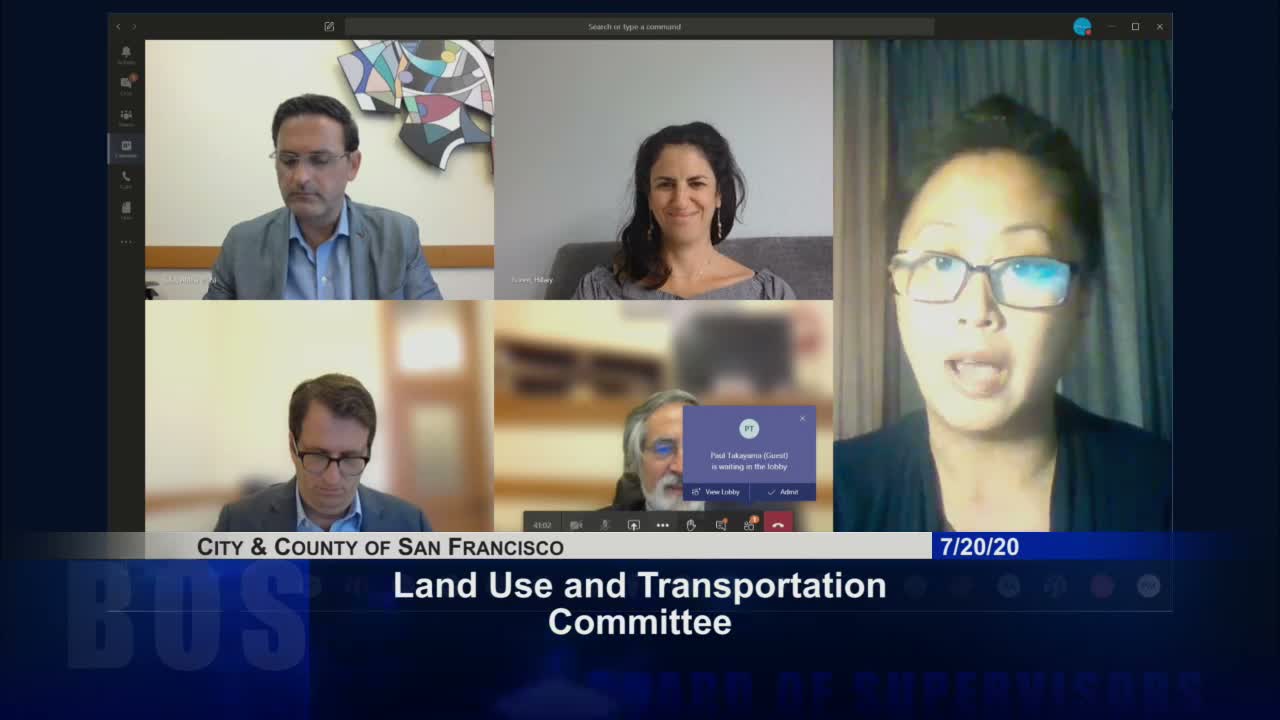
Supervisor Hillary Ronan urged the Land Use and Transportation Committee on Monday to adopt a new temporary use permit designed to activate empty storefronts and give nonprofit arts, cultural and social‑service organizations a low‑cost option to operate while they recover from the COVID‑19 economic downturn.
"Anywhere you go in the city, you see dozens of empty storefronts lining our most important commercial corridors," Ronan said, arguing a streamlined permit would help organizations provide food distribution, financial assistance and pop‑up testing during the pandemic while avoiding blight.
The proposal would allow nonprofit uses in vacant commercial storefronts for an initial period of up to two years and—if the planning director approves—an optional extension of up to two additional years, for a total potential duration of four years. Planning staff said the Planning Commission recommended defining COVID‑19 relief and recovery uses and granting a fee waiver for those relief uses; staff also described the extension language and the fee changes that are now included in the draft ordinance.
Public commenters — including practicing artists and nonprofit operators — described repeated displacement and rising rents and urged supervisors to adopt measures that preserve arts and manufacturing workspace. Artists recounted losses of studios and asked the Board to provide a quicker, lower‑cost alternative to formal lease negotiation.
Procedural concerns over the changes surfaced during committee consideration. Planning staff advised that the set of amendments expands allowable uses in a way that requires additional public notice. In response the committee voted to adopt the proposed amendments but also to continue the item, by motion, to the July 27 meeting so the public can be properly notified of substantive changes. The continuation passed on a unanimous 3‑0 voice roll call among committee members present (Preston, Safaei, Peskin).
Next steps: Committee members expect the item to return on July 27 with the adopted amendments fully noticed. If approved by the full Board after committee action, the ordinance would create a temporary, lower‑barrier pathway for community organizations to occupy vacant storefronts during the city’s COVID‑19 recovery period.