Get Full Government Meeting Transcripts, Videos, & Alerts Forever!
Get email alerts on the Budget Forecast topic
No spam. Unsubscribe anytime.
Controller projects $172M year‑end General Fund balance; two‑year shortfall trimmed to $148M
Summary
The controller’s nine‑month report projects a $172 million General Fund ending balance and a $43.3 million improvement versus the six‑month forecast, trimming the city’s two‑year shortfall to approximately $148 million and $290 million for FY2012–13 and FY2013–14. The committee filed the report and continued a related budget‑instruction item.
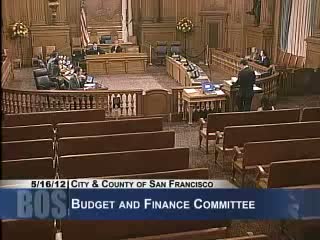
The Budget and Finance Committee on Tuesday filed the controller’s nine‑month budget status report, which shows a stronger‑than‑expected local economy and a projected $172,000,000 General Fund ending balance for the current fiscal year.
The controller’s office told the committee the $172 million outlook is about $43 million better than the six‑month projection and reflects roughly $20.7 million in improved tax revenue — driven primarily by payroll taxes and higher property transfer taxes — along with about $42.4 million in net departmental operating savings, of which roughly $34 million is attributable to the Human Services Agency (HSA).
“The $43 million in good news is being driven almost in even parts by improvement in our local revenue picture and departmental expenditure savings,” Mr. Rosenfield of the controller’s office said, summarizing the report.
Nut graf: Why it matters — the improvement reduces but does not eliminate the city’s multi‑year budget gap. Mayor’s budget staff said the additional fund balance will be spread over two years and lowers the previously reported shortfalls of $170 million and $312 million to about $148 million and $290 million for the next two fiscal years, respectively.
Kate Howard, the mayor’s budget director, told supervisors the administration will use the improved fund balance to reduce both years’ shortfalls by about $22 million each and is continuing stakeholder outreach, including district town halls and a recent web‑based town hall. Howard also reviewed labor‑negotiation outcomes: 27 labor contracts were amended (all but nurses), with no first‑year wage increase and a phased second‑year increase that the administration is budgeting as roughly a 1.75 percent cost; these agreements are expected to produce an estimated $20–25 million in second‑year savings compared with prior assumptions.
The report cautioned about a mixed revenue picture: while payroll and transfer taxes rose, property tax estimates were revised downward because of unexpectedly successful assessment appeals. Rosenfield noted that voter‑mandated property‑tax set‑asides (the Children’s Fund, Open Space Fund and Library Preservation Fund) will see reductions versus the six‑month forecast (roughly $1.2 million, $1.0 million and $1.0 million, respectively), which will affect multi‑year planning even if current‑year spending remains supported by available balances.
On reserves, the report projects a General Reserve of about $22.3 million after a $2.7 million appropriation for nurse wage increases; a Budget Savings Incentive Reserve projected at $18.3 million (retaining 25 percent of departmental operating savings for one‑time efficiency projects); a Rainy Day Reserve at roughly $25 million (the school district may be eligible to draw 25 percent annually under current triggers); and a Budget Stabilization Reserve at about $27 million.
Supervisors questioned how the rainy day reserve and school‑district draws would play out in future years; the controller said the district appears likely to be eligible for annual draws for the foreseeable future given projected gaps between local per‑pupil spending and state allocations.
The committee approved (no objection recorded) a motion to file the nine‑month report and continued the related budget instructions and fiscal‑year update to the call of the chair, meaning the substance of the report will be used in upcoming budget hearings beginning with the mayor’s two‑year budget introduction on June 1 and detailed departmental hearings in June.
Looking ahead: the committee will consider enterprise department budgets in the coming weeks, with full board action expected in July and mayoral signature in early August.