Get Full Government Meeting Transcripts, Videos, & Alerts Forever!
Get email alerts on the Redevelopment topic
No spam. Unsubscribe anytime.
City outlines successor agency plan after state dissolves redevelopment; community groups warn of workforce and housing gaps
Summary
City officials described the successor agency structure required by AB 26, said major projects (Mission Bay, Transbay, Hunters Point/Candlestick) can continue under recognized enforceable obligations, and warned the Department of Finance will review obligations on a 10‑day timetable; community providers urged bridge funding for job‑readiness programs facing June 30 contract expirations.
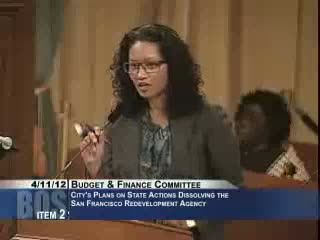
Tiffany Bohe, director of the successor agency for the former San Francisco Redevelopment Agency, told the Budget & Finance Committee that state legislation (AB 26) and a subsequent state supreme court ruling dissolved redevelopment agencies statewide and required the city to create a successor structure to preserve enforceable obligations.
Bohe summarized actions the board took in January to step into a successor role: the city assumed redevelopment assets and obligations, transferred affordable‑housing assets to the Mayor’s Office of Housing (MOH), and confirmed appointments to an oversight board charged with reviewing claims that can continue to draw tax increment. She said the successor agency can continue to implement three "major approved development projects" — Mission Bay, Transbay and Hunters Point/Candlestick — under enforceable obligations recognized by the oversight board and the state.
"There is a new structure for redevelopment activities that are mandated by the state dissolution resolution that is AB 26," Bohe said, adding that only obligations recognized by the oversight board and the Department of Finance can be funded with tax increment.
Bohe reported staffing and transition figures: the former redevelopment agency had about 101 positions; the city retained 56 positions across the city administrator’s redevelopment division, MOH and the Port, and about 40 layoffs occurred as of March 30. She said bargaining and transition assistance for displaced workers are ongoing, and that the city is exploring civil‑service and other options to place affected employees.
Budget staff explained AB 26 provides a temporary administrative cap of 5 percent on allowable administrative expenses for the current fiscal year (falling to 3 percent thereafter) after statutory pass‑through payments. The presentation noted approximately $14 million in statutory pass‑throughs and estimated the successor agency’s 5 percent administrative allowance would translate to roughly $3 million available for administrative costs after those pass‑throughs.
Olson Lee, director of the Mayor’s Office of Housing, discussed housing assets transferred to MOH and the agency’s replacement housing obligation. MOH’s submission to the state lists a replacement obligation tied to earlier demolition of affordable units; Lee said redevelopment previously recorded about 6,700 demolition‑era affordable units that must be replaced and that the former agency had about $200 million left at dissolution, with $160–170 million already encumbered by contracts.
Bohe said the successor agency submitted a Recognized Obligation Payment Schedule (ROPS) to the state; the Department of Finance has a 10‑day review period to accept or request more documentation on what the city has listed as enforceable obligations. "We submitted it last night to the state immediately after our oversight board unanimously acted," she said.
Supervisors and many public commenters pressed the administration on workforce and Job Readiness Initiative (JRI) contracts that currently support community‑based job placement and barrier removal. Providers warned that many JRI and related contracts expire June 30 and said their organizations need bridge funding or clear paths to other funding sources. Jamie Brewster of Asian Neighborhood Design and Bridal Andrews of Positive Resource Center gave figures for program costs and called for continued funding; Young Community Developers representatives said contract terminations would immediately disrupt training and placement services.
Community speakers also demanded better public notice, clearer contact points for homeowners with outstanding loan or subordination questions, and ongoing transparency from the oversight board; the oversight board website (sfgov.org/oversightboard) was cited during comment as a resource the public should use.
The committee continued Item 2 to the call of the chair for further updates as the city awaits state review of the ROPS and prepares budget submissions to carry out recognized obligations.