Get Full Government Meeting Transcripts, Videos, & Alerts Forever!
Get email alerts on the Criminal Justice Reform topic
No spam. Unsubscribe anytime.
Supervisors press agencies for tighter coordination after deaths tied to people on supervision; SFPD, DA, probation and sheriff outline fixes
Summary
A multi‑hour hearing examined rearrests of people on parole/probation, links to substance use and gaps in interagency communication. SFPD announced double‑check notifications and policy updates; the District Attorney described higher filing rates for repeat arrestees and proposed a fentanyl task force; probation, sheriff and pretrial services outlined data and service limits and urged improved shared technology and treatment capacity.
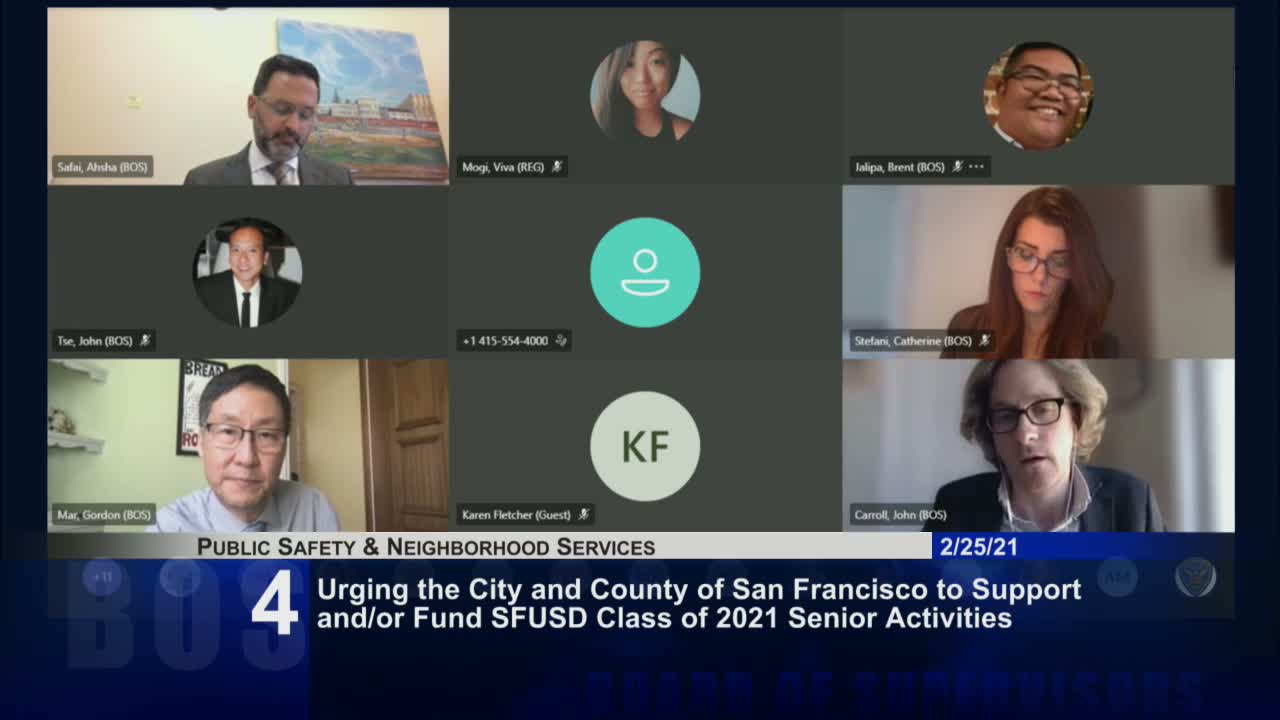
The Public Safety & Neighborhood Services Committee held an extended hearing to analyze "loopholes and areas of failure" in the criminal justice system for people on parole, probation or pretrial supervision, focusing on recent incidents that resulted in tragic deaths and on whether repeat arrests are driven by substance use and gaps in supervision.
Supervisor Asha Safai said the goal was to identify points of intervention and improve coordination among the SFPD, District Attorney’s Office, Adult Probation, Sheriff’s Department, pretrial services and state parole representatives. Law‑enforcement and justice officials described gaps in communication and technology and proposed near‑term and systemic changes.
SFPD Deputy Chief David Lazar described the arrest‑to‑booking process, cited statistics showing that roughly half of arrested adults had multiple prior arrests in recent years, and said the department will revise a 1994 general order to clarify when officers must notify parole and probation. He said SFPD will implement an investigator verification "double check" so that a field officer's notification is verified before the case is closed.
District Attorney Chesa Boudin said his office increased filing rates in 2020 for frequent arrestees and is pursuing a memorandum of understanding (MOU) to codify interagency notifications and responsibilities; he also proposed a DA‑led fentanyl task force and emphasized the need for treatment on demand and improved data infrastructure. Boudin said his office cannot ethically file criminal charges unless the evidence meets the legal standard (beyond a reasonable doubt) but that revocation proceedings and probation filings are different tools with lower standards.
Chief Karen Fletcher (Adult Probation) presented case‑level data: APD supervises roughly 6,100 clients (82% for felony supervision), 79% of those have moderate or high risk/needs, and in a three‑year window ~2,113 supervised clients accounted for 5,338 booking events; among those with 5+ bookings, African Americans were overrepresented. APD described its graduated sanctions, use of motion‑to‑revoke filings, and barriers such as limited treatment bed capacity.
Sheriff Paul Miyamoto and pretrial providers described in‑custody substance‑use programming (with pandemic limits), discharge planning and linkage challenges. David Moroff (San Francisco Pretrial Diversion) outlined pretrial supports, described pandemic impacts on in‑person check‑ins and group work, and urged city support for community hubs, technology access and a coordinated aftercare approach.
Supervisors pressed agencies on specific failures cited in press reports, the mechanics of parole holds, whether holds were placed, and how to reduce delays for people clinically appropriate for residential treatment. Officials agreed on the need for redundancies, clearer notification protocols, a shared MOU, better data systems and more treatment capacity. The committee voted to continue the item to the call of the chair for follow‑up and further work on the MOU, technology upgrades, and treatment availability.