Get Full Government Meeting Transcripts, Videos, & Alerts Forever!
Get email alerts on the Sro Protections topic
No spam. Unsubscribe anytime.
Committee advances emergency SRO protections and eviction ban to full Board after advocates press for testing and hotel rooms
Summary
The Land Use & Transportation Committee voted to send two COVID‑19 emergency ordinances — one mandating public‑health protocols and reporting for SROs and another banning certain evictions and fees — to the full Board of Supervisors, after advocates and tenants described outbreaks in shared residential hotels and urged urgent testing, isolation and rent relief.
The San Francisco Board of Supervisors’ Land Use & Transportation Committee voted May 18 to forward an emergency package of protections for single‑room‑occupancy (SRO) residents to the full Board for a May 19 hearing, after a lengthy presentation and dozens of public comments from tenants and service providers.
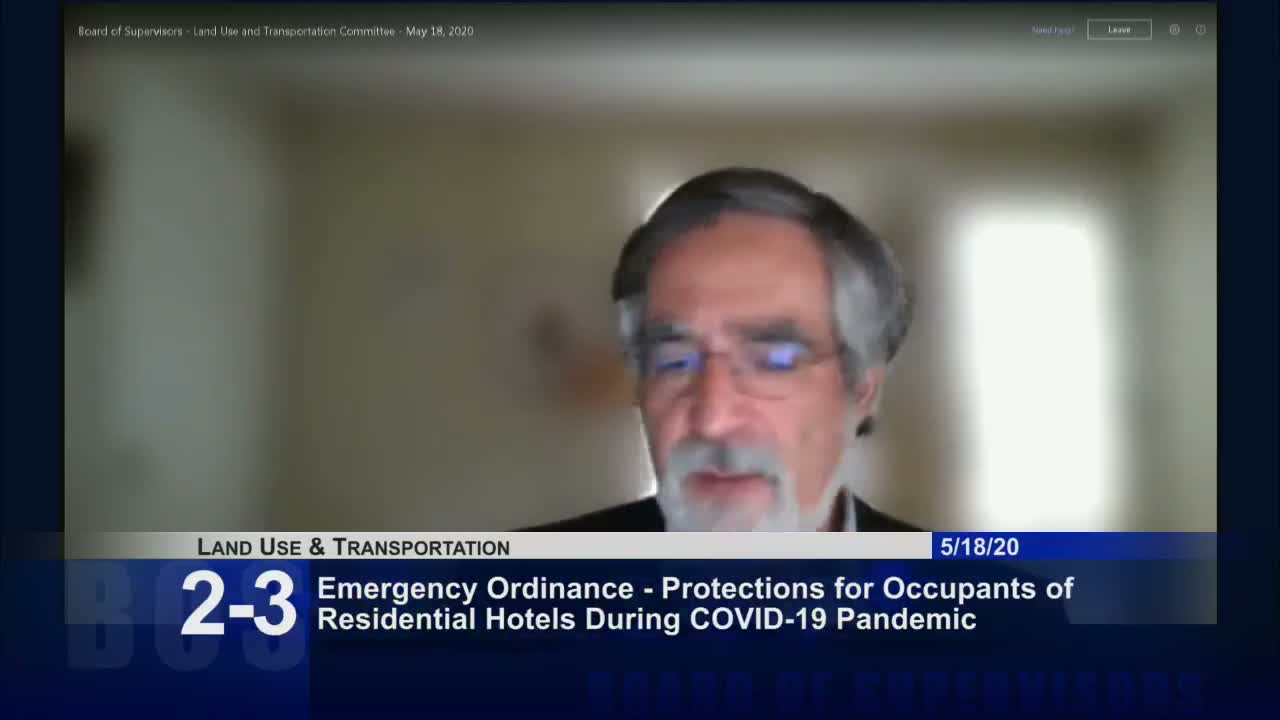
Sponsor Supervisor Aaron Peskin said the ordinances (items 2 and 3) would require the Department of Public Health to carry out culturally competent SRO contact notification, case investigation, community education, testing, and isolation and quarantine support. The package also includes eviction protections, rent relief and a right to return to units for residents who quarantine.
The committee heard data from Gen. Fujioka summarizing verified COVID‑19 test results in SRO buildings. Fujioka told the committee that, between April 1 and data through May 11, the number of SRO buildings with positive tests rose from 8 to 53 and residents testing positive rose from 9 to 144; Chair Peskin said the count had increased to 176 as of the previous day.
Public commenters — including tenant organizers, SRO residents and advocacy groups such as the Coalition on Homelessness and Senior and Disability Action — urged immediate priorities: prioritized testing in SROs, timely notification to providers and residents when cases are identified, quarantine and isolation rooms (preferably in hotels), and protections to prevent illegal displacements. Service providers described operational problems, including delays getting test results and insufficient notifications to building operators.
The committee approved a set of non‑substantive amendments to item 2 (timing language clarifying "as soon as feasible but not more than 12 hours after receiving such confirmation," and related clarifications about providing face coverings) and then voted to send item 2 as amended and item 3 as written to the full Board as committee reports. The roll calls recorded Supervisors Preston, Safaie and Peskin voting Aye on the motions.
The package’s sponsors said the ordinances aim to reduce intra‑building transmission in congregate SRO settings where shared bathrooms and kitchens make self‑isolation difficult, and to ensure transparent SRO‑level reporting of confirmed COVID‑19 cases. The committee did not take final action; the items will be debated and voted on by the full Board of Supervisors at its next hearing.
What’s next: The items were sent to the full Board with committee recommendations; the Board will consider the ordinances at the May 19 hearing, and staff said additional non‑substantive edits could be finalized before then.