Get Full Government Meeting Transcripts, Videos, & Alerts Forever!
Get email alerts on the Substance Use Treatment topic
No spam. Unsubscribe anytime.
Recovery Summit working group urges more treatment options, longer stays and Black‑led programs as DPH defends harm‑reduction approach
Summary
Members of the Recovery Summit Working Group told the Board of Supervisors committee that San Francisco needs to expand residential, abstinence‑based and culturally specific treatment, extend stays beyond Drug Medi‑Cal limits and create Black‑led programs in the Bayview; Department of Public Health said it is expanding low‑threshold access to medication and other supports and invited continued collaboration.
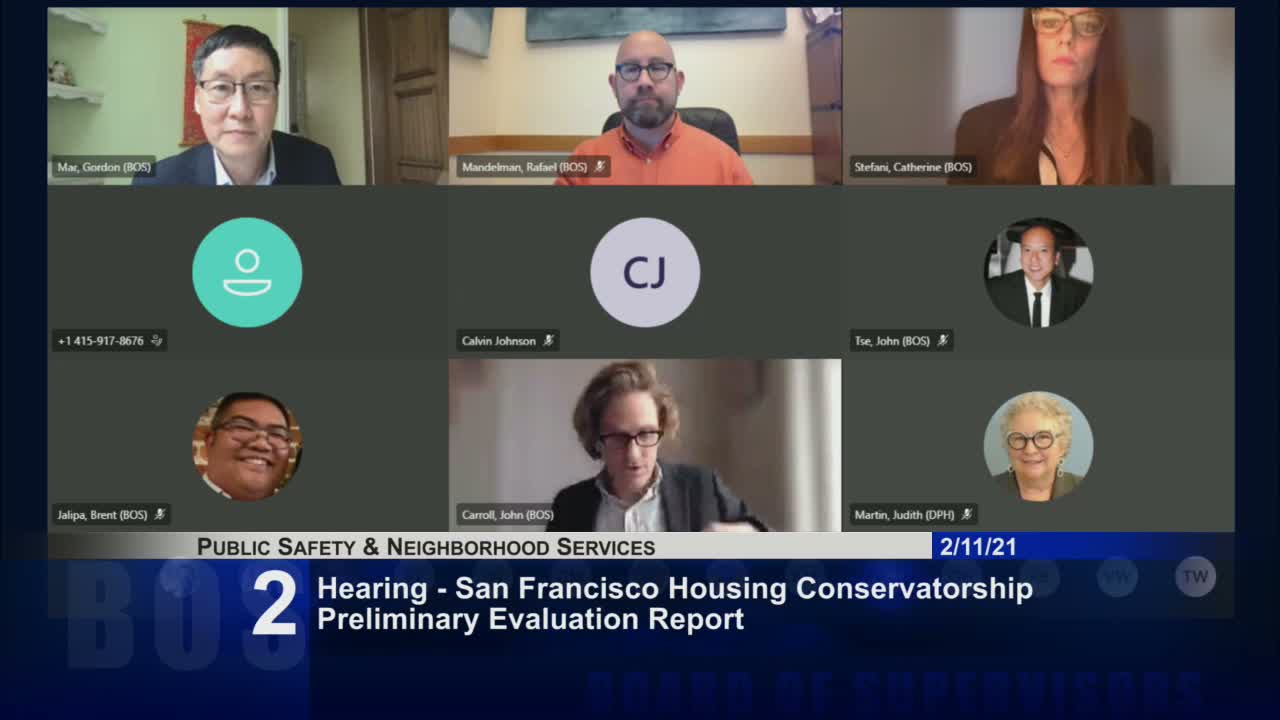
Vice Chair Catherine Stephanie convened a lengthy Feb. 11 hearing of the Board of Supervisors’ Public Safety and Neighborhood Services Committee to consider the San Francisco Recovery Summit Working Group’s report on gaps in the city’s addiction‑treatment system. The working group, made up largely of people in recovery, recommended expanding treatment options to include abstinence‑based, faith‑based and social‑model residential programs, extending lengths of stay, creating Black‑led facilities in the Bayview, increasing paid peer specialist opportunities and improving public awareness of services.
The working group and people with lived experience emphasized the urgency of the crisis. "The drug overdose crisis in our city has reached an unprecedented level," Vice Chair Stephanie said, citing 699 overdose deaths in 2020. Steve Adame, interim director of the Reentry Division at Adult Probation and a working‑group member, described local counts and trends — including syringe distribution and overdose reversals — to illustrate the scale of need and argued the city must enlarge the "solution space" to meet people where they are.
Members of the working group recited survey findings and first‑person testimony. That survey — administered online and on paper in English, Spanish and Cantonese — reported several patterns the group considered important: many respondents began using before age 24; a majority had long treatment histories; respondents favored longer residential stays and specialized programs for transitional‑age youth; and respondents prioritized a wider array of modalities, from harm reduction to abstinence‑based residential care. Cedric Akbar and others argued that Department of Public Health contracting requirements and Drug Medi‑Cal certification criteria have made it difficult for abstinence‑focused and smaller community providers to win city contracts.
The Department of Public Health’s medical director for substance‑use services, Dr. Judith Martin, acknowledged the gaps and the racial disparities speakers described and laid out the agency’s current and planned work. DPH said it is pursuing several expansions aimed at preventing overdose and improving access: low‑threshold buprenorphine access at harm‑reduction sites, contingency‑management programs for stimulant use disorder, expanded pharmacy hours and step‑down/transitional beds tied to outpatient care. "A person who has buprenorphine in their body is 95 percent protected against overdose from fentanyl," Dr. Martin said, and she emphasized that DPH’s approach treats abstinence as a valid goal while also keeping people engaged if they relapse.
Supervisors pressed both sides about implementation and measurement. Supervisor Matt Haney and others asked how the city would do more street‑level outreach and better link people in shelter‑in‑place hotels, navigation centers and other settings to residential care. Dr. Martin described work to expand street medicine, naloxone distribution, teleaccess to buprenorphine, and programs to deliver medications and provide outreach in SIP hotels, and she said DPH is tracking metrics that include naloxone distribution, unique individuals enrolled in medication treatment, and racial disparities in overdose outcomes.
Throughout the hearing, speakers urged that harm reduction and abstinence‑based approaches should not be presented as mutually exclusive. Working‑group members asked for explicit city support and funding pathways for culturally specific, Black‑led abstinence programs in the Bayview and other neighborhoods; community callers and providers testified about unmet need and the value of local, community‑led models such as Cameo House and Positive Direction Equals Change.
The committee did not adopt new policy at the hearing, but Vice Chair Stephanie moved to continue the matter to the call of the chair so supervisors, DPH, and the working group can continue negotiating concrete next steps. The motion passed on a 3‑0 roll call.