Get Full Government Meeting Transcripts, Videos, & Alerts Forever!
Get email alerts on the Debt And Capital Plan topic
No spam. Unsubscribe anytime.
Comptroller: San Francisco's GO bond capacity remains well below charter limit amid planned issuances
Summary
Comptroller's office staff told the audit committee the city's current general-obligation (GO) bond use is about 1% of assessed valuation (below the 3% charter cap), described voter-authorized bond authorizations and conservative modeling assumptions, and outlined overlapping debt exposures from schools, community college and BART.
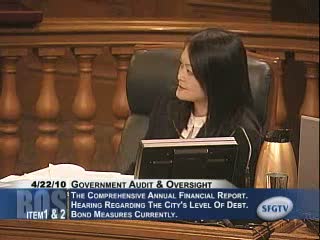
Comptroller's office staff briefed the Government Audit and Oversight Committee on April 22 on the City and County of San Francisco's debt portfolio and the assumptions in the 10-year capital plan, concluding the city currently uses about 1% of its GO bond capacity and maintains substantial remaining authorization under the local 3% charter limit.
"In fact, as of today, our capacity is just 1%," said Nadia Sisay of the Comptroller's Office of Public Finance. Sisay explained that state law allows GO bonding up to 5% of assessed value while the local charter sets a more stringent 3% cap, and that the city models its capital program conservatively (assumptions discussed included assessed-valuation growth rates and 6% interest-rate assumptions).
Sisay reviewed voter-authorized and outstanding authorizations, noting 2008 general-obligation authorizations of about $887,400,000 and voter-approved authorizations for the Unified School District (~$745,000,000 aggregate) and City College (~$441,500,000 aggregate), while BART had an authorization cited as approximately $980,000,000. She said these overlapping authorizations are excluded from the city's charter GO limit but contribute to an overlapping tax base when considered together.
Capital-planning staff described a policy assumption to set aside approximately 3.25% of general-fund discretionary revenues for debt-related purposes as part of the capital plan modeling; staff also noted that refunding and portfolio restructuring are tools used to manage capacity over time.
Supervisors asked about integrating parcel taxes and enterprise revenue bonds into an overall picture for taxpayers; Sisay replied parcel taxes are dollar levies (not debt) and would require a separate analysis to show taxpayer impacts, while enterprise issuances (PUC and airport revenue bonds) are generally paid by ratepayers or users and are modeled separately. Sisay reported the PUC is expected to issue about $2.6 billion and the airport about $145 million in upcoming revenue issuances.
Staff offered to return with more detailed breakdowns of overlapping debt and the capital plan's assumptions; the committee continued the overlapping-debt item to the call of the chair for further review.