Get Full Government Meeting Transcripts, Videos, & Alerts Forever!
Get email alerts on the Cafr Audit Results topic
No spam. Unsubscribe anytime.
External auditors give San Francisco an unqualified opinion but flag control deficiencies
Summary
External auditors told the audit committee they issued an unqualified opinion on the City's FY2009 financial statements while identifying four significant internal-control deficiencies and several lesser issues, and highlighted a new pollution remediation liability of over $30 million.
External auditors told the Government Audit and Oversight Committee on April 22 that they issued an unqualified opinion on the City and County of San Francisco's fiscal year 2009 financial statements, but called attention to several internal-control weaknesses that warrant committee oversight.
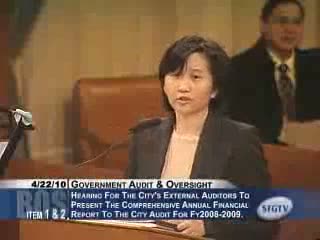
"We issued an unqualified opinion on the city's financial statements, which is the highest level of assurance," said Cindy Pahn, partner with MGO, the city's external auditor. Pahn summarized the CAFR (Comprehensive Annual Financial Report) and related single-audit materials and said the auditors did not identify a material weakness but did identify four significant deficiencies.
Those significant deficiencies included segregation-of-duties issues in the Redevelopment Agency's journal-entry processes, two Port of San Francisco matters (information-systems disaster-recovery planning and physical inventory of capital assets), and a general-city capital-asset database problem. Pahn also highlighted three other less-severe control deficiencies relating to the computation and review of net-asset calculations, internal-control issues over interdepartmental billings, and untimely subrecipient monitoring of federal grants.
The auditors also noted two informational matters: a required accounting change for pollution-remediation obligations that increased reported liabilities by "over $30,000,000," and heightened federal grantor requirements tied to stimulus (ARRA) funding. "The remaining communications are similar to prior years," Pahn said.
Controller Ben Rosenfield told the committee the city's legacy financial platforms require substantial manual workarounds to produce the CAFR. "FAMIS is a legacy system of the city," Rosenfield said. "It is becoming more and more outdated in terms of generating financial statements and financial reporting," he added, noting the board has appropriated funds to begin multi-year planning work to replace the system.
KPMG's partner Steve De Vetter reported department-level audits that produced unqualified opinions and identified two internal-control comments at the Municipal Transportation Agency (MTA): weaknesses in inventory-count controls and issues in the year-end financial-statement review, including one line item placed in the wrong section of the statement of cash flows when Muni and Parking & Traffic were consolidated.
Committee members pressed departments for corrective plans. MGO and KPMG recommended bringing deficiencies to the attention of those charged with governance but noted they were not classified as material weaknesses. Several supervisors asked departments to report back with implementation plans, particularly on the Port's disaster-recovery items and on replacing or upgrading the legacy financial systems that require extensive manual reconciliation.
The committee filed the auditors' presentations as an official record of the meeting and requested follow-up from departments on implementation timelines and corrective steps.