Get Full Government Meeting Transcripts, Videos, & Alerts Forever!
Get email alerts on the Transit Fare Evasion topic
No spam. Unsubscribe anytime.
Budget analyst finds Muni proof-of-payment program lacked clear objectives; MTA outlines deployment and training steps
Summary
A budget analystaudit told the Boardcommittee that San FranciscoMTAproof-of-payment (POP) operations lacked clear objectives and strategic deployment, and recommended changes including targeted staffing and higher penalties. The MTA said it has adopted many recommendations and provided data on inspections and citations.
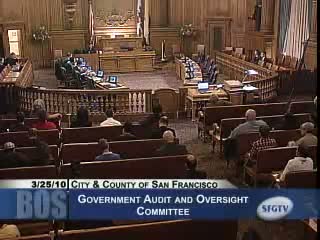
The Government Audit and Oversight Committee heard testimony on the Municipal Transportation Agency's proof-of-payment (POP) program after a budget analystaudit concluded the program lacked clear objectives and strategic deployment.
Ian Hart, lead analyst in the budget and legislative analyst's office, told the committee the POP program "neither the MTA nor the POP had defined clear objectives for proof of payment," and that deployments and citation practices had not been shown to curtail fare evasion. Hart cited staff scheduling that "peaked during late morning and early afternoon lulls" rather than rush hours, and recommended strategic redeployment tied to ridership, stronger performance measures and annual staff reviews.
Hart said San Francisco's fine structure had lagged peer systems (adult citation then $75) and the federal guidance for POP systems suggested higher penalties or escalations for repeat offenders; he said the budget analyst recommended increasing the citation to $100 if escalation for repeat offenders was not available. He also advised system exclusion for chronic offenders and alternative-sentencing options for low-income people. The audit team reported inspection-rate estimates (about 7.4% including special events, roughly 3.4% excluding them) and a light-rail fare-evasion rate of about 2.4% for the study period (January 2007January 2009).
MTA Director of Safety and Security Enforcement Jim Daugherty said the agency had accepted many of the analyst's recommendations and described changes already under way. "Our success is gonna be based on riders paying their fare," Daugherty said, summarizing the MTA's shift toward prevention and customer-friendly enforcement. He said the MTA has expanded saturations to buses as well as rail, coordinated saturations with SFPD officers and undercover plainclothes deployments, and is reporting monthly inspection metrics for management use.
Daugherty provided operational numbers covering July 27 through March 19, 2010: 130 saturation operations and 326,293 saturation inspections; across regular (non-saturation) inspections the MTA reported 1,276,593 inspections and 18,821 citations for the period cited in its slides (a combined inspection-to-warning/citation rate the agency calculated as 2.59%). He told the committee the POP staff complement remained 46 inspectors with five supervisors and that hiring additional inspectors has been proposed but is currently constrained by budget realities.
On collections, Daugherty estimated a 5060% collection rate on citations and said citation revenues had increased by about $900,000 year-over-year in recent reporting. On safety and training, the agency reported new performance-appraisal standards (SMART goals), conflict-resolution training for POP staff and plans to pilot handheld devices for citation issuance and to build a linked incident-report database.
Supervisors pressed for clarification on juvenile citations (which, Hart and MTA staff said, remain criminal under California law), whether citation revenue and collections offset staffing costs, and whether the MTA had evidence that adding inspectors increases fare compliance. The MTA said it was studying metrics to better attribute revenue gains to POP deployment and that some recommendations remain in progress.
Public commenters at the hearing described varied experiences: some riders said enforcement can impose hardship on low-income or disabled riders, while POP inspectors and union-affiliated staff described customer-service and life-saving interventions by inspectors. The committee moved to file the hearing and the item was filed.
The committee asked departments to provide follow-up details on collections, juvenile-citation policy, and how MTA deployment and performance metrics will be tracked; the committee recorded the audit and MTA response for the April 6 Board of Supervisors agenda.