Get Full Government Meeting Transcripts, Videos, & Alerts Forever!
Get email alerts on the Mental Health System Reform topic
No spam. Unsubscribe anytime.
DPH lays out Mental Health SF priorities, cites bed, staffing and budget constraints amid COVID-19
Summary
Department of Public Health officials described a phased Mental Health SF implementation that prioritizes an Office of Coordinated Care, bed-capacity investments and crisis-response teams; DPH cited modeling that suggests roughly $11M initial investment to reduce wait times and an annual $13M cost to expand access to 24/7 behavioral-health urgent care, and warned hiring and real-estate constraints will slow implementation.
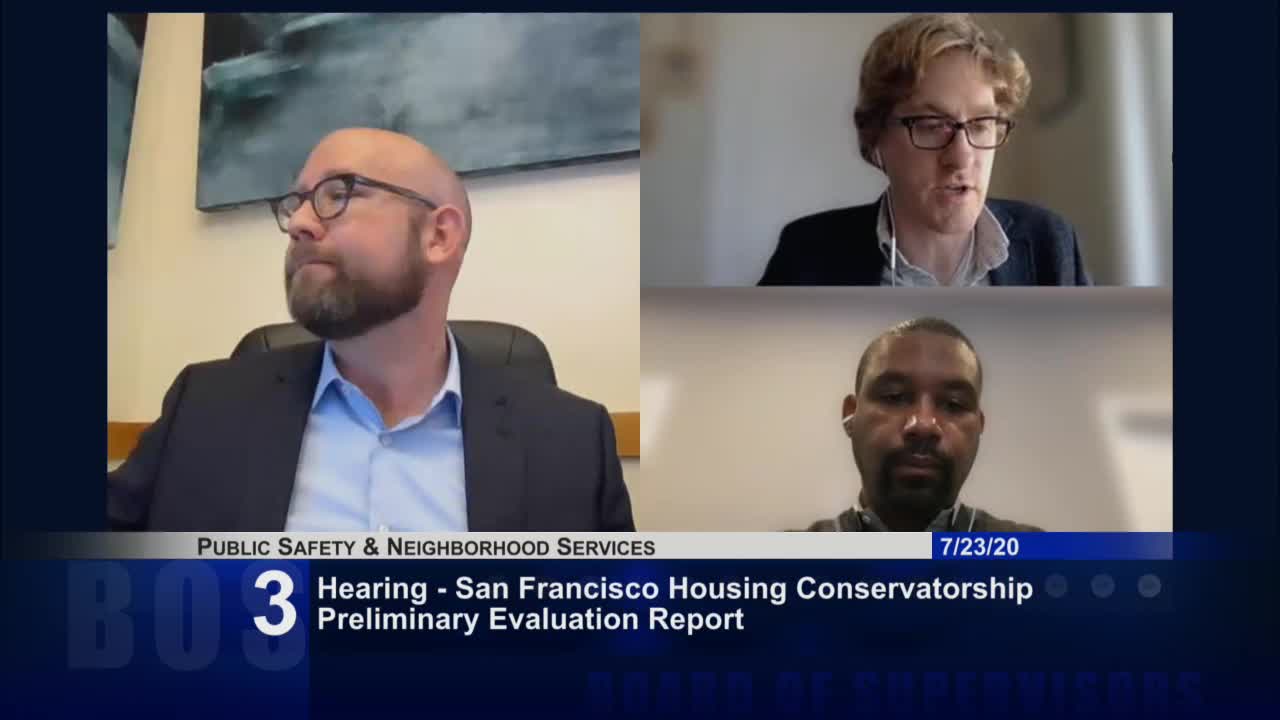
On July 23 the Department of Public Health told the Public Safety & Neighborhood Services Committee it will use a phased approach to implement Mental Health SF amid COVID-19 budget constraints, prioritizing an Office of Coordinated Care, bed-capacity and flow improvements, crisis-response teams, and planning for an expanded mental-health services center.
Dr. Hallie Hammer, Director of Ambulatory Care for the San Francisco Health Network, described recent COVID-19 trends and said hospitalizations that spiked in late June have begun to plateau. Hammer said DPH is proposing to begin implementation this fiscal year by focusing on a small set of high-leverage priorities rather than a full rollout.
Key elements discussed included:
- Office of Coordinated Care: a centralized body to improve access, data collection, staff training, outreach materials and a bed-tracking system; DPH estimated foundational staffing and coordination could be stood up with a multi-million-dollar investment in hiring and administrative capacity.
- Bed capacity and flow: DPH and its analysts (Anton Neguse Bland) presented bed-optimization modeling suggesting that a modest but strategic investment (the committee heard "a little over $10,000,000" in modeling cited earlier) could significantly reduce wait times.
- Crisis response and places to go: DPH proposed crisis-response teams modeled on the Kayoots/Kahoots approach (call, response, place to go, linkage to care) and emphasized the importance of sobering centers and urgent-care options that allow outreach teams to bring people to a safe temporary location rather than police or PES when appropriate.
DPH offered order-of-magnitude figures to guide planning. Officials cited a modeling estimate of "a little over $10,000,000" (previously described in the BEDS study) to dramatically reduce wait times and noted that expanding the Behavioral Health Access Center to operate 24/7 would cost roughly $13,000,000 annually. Hammer said these figures are unit-cost estimates and require careful planning, and that the primary operational barriers are hiring capacity and real-estate availability to stand up beds and centers.
DPH also told the committee it is already working with more than 2,100 people who were previously unsheltered and are now in SIP (shelter-in-place) hotels; those placements have revealed higher-than-expected clinical needs and contributed to staffing constraints because DPH redeployed clinical staff to support the hotel population.
Supervisors asked about coordination with HSOC, outreach to new encampments, mixing of residential treatment and sober-living steps, and how investments would translate into on-the-ground options for people in crisis. DPH responded that hiring is the main barrier to rapidly scaling the Office of Coordinated Care and that real-estate procurement remains a major obstacle to standing up residential and sobering capacity.
Public commenters urged swift implementation, funding for street crisis-response teams, and stronger coordination; some neighborhood groups emphasized safety concerns and enforcement as part of broader solutions.
DPH said it is working to post and hire a director of behavioral health reform to lead Mental Health SF implementation and will return to the Board and committees with more concrete budget proposals as planning progresses and hiring and procurement steps advance.
The committee filed the hearing record and urged the mayor and Board to consider the DPH priorities in the upcoming budget process.