Get Full Government Meeting Transcripts, Videos, & Alerts Forever!
Get email alerts on the Nonprofit Funding topic
No spam. Unsubscribe anytime.
Supervisors hear unified plea for COLA and cost‑of‑doing‑business increases for nonprofit contractors
Summary
At a Budget & Finance Full Committee hearing, nonprofit leaders, union representatives and city budget staff debated flat funding’s impact on services and presented controller estimates that a 2.93% COLA would cost roughly $15.6 million including UC contracts; the mayor’s office made no funding commitment and the item was filed.
The San Francisco Board of Supervisors' Budget and Finance Full Committee spent more than three hours Wednesday hearing testimony from nonprofit providers, unions and city budget staff on how five years of largely flat contract funding have strained services and staff.
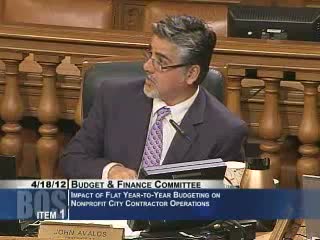
Chair Carmen Chu opened the session by noting the item was brought by Supervisor John Avalos and co‑sponsored by President Chu, and the clerk read the agenda description as a hearing to "consider the impact of flat year to year budgeting on nonprofit city contract operations and services" and to examine possible cost‑of‑doing‑business and cost‑of‑living increases for contractors.
Leo Levinson, director of Budget and Analysis in the controller’s office, presented department‑level contract spending and cost estimates. He said the bulk of nonprofit contract dollars flow through the Department of Public Health (split between UC and non‑UC contracts), the Human Services Agency and the Department of Children, Youth and Families. Levinson told the committee that funding a 2.93% COLA at the controller’s projection would be about "$15,600,000" if UC contracts are included and about "$11,700,000" if they are excluded, and that each 1% increase would be in the low‑millions depending on the contract universe.
Mayor’s Budget Director Kate Howard told the committee the mayor had been meeting with nonprofit providers but "at this point, the mayor has not been able to make a commitment to providing a COLA for nonprofit organizations," citing an estimated structural shortfall the administration expects to address in the budget process.
From the public, dozens of nonprofit executives, frontline workers and union representatives described program closures, layoffs and heavier caseloads tied to flat contract funding. Jennifer Friedenbach, executive director of the Coalition on Homelessness, said cuts since 2008 have meant "brutally long waits for life saving services" and reduced the city’s safety net. Progress Foundation’s Steve Fields told supervisors flat funding has produced hidden service reductions and higher worker turnover, saying "flat funding ... is a cut" and warning organizations are "going underwater." Union spokespeople and many front‑line staff urged a 3% COLA and a standing cost‑of‑doing‑business adjustment to be added to the city budget.
Nonprofit leaders also described rising non‑personnel costs that contracts often do not cover: health insurance, workers’ compensation and rents. Gail Gilman of Community Housing Partnership noted that departments cap indirect (overhead) rates differently and that agencies cannot reliably include escalators in competitive bids because proposals with higher costs are routinely rejected.
Supervisors pressed for concrete funding ideas. Supervisor Wiener emphasized the trade‑offs required without new revenue: "Either that $581,000,000 number stays the same and then you give raises and it has to come from somewhere within that pie, or we increase the $581,000,000." Several speakers urged revisiting business tax policy to recapture revenue lost in prior settlements with large corporations.
After public testimony, supervisors thanked witnesses and reiterated the need to find a pathway in the budget. No formal citywide COLA commitment was announced by the mayor’s office during the hearing. Supervisor Avalos moved to file the item; the motion was taken "without objection." The committee indicated staff and the mayor’s budget office will continue to examine options as the budget process progresses toward June budget hearings.
What happens next: The discussion will continue in the mayor’s budget office and during the board’s add‑back and budget deliberations; supervisors and advocates signaled they will press for either a COLA line or a designated cost‑of‑doing‑business appropriation in the fiscal year budget cycle.