Get Full Government Meeting Transcripts, Videos, & Alerts Forever!
Get email alerts on the Nonprofits topic
No spam. Unsubscribe anytime.
Grand jury urges nonprofit oversight and end to targeted add‑backs; city departments and nonprofits favor coordinated implementation
Summary
A civil grand jury report flagged procurement, monitoring and a budget practice called add‑backs affecting nonprofits; departments acknowledged monitoring gaps and recommended using existing task forces and a citywide grants tracking approach rather than abrupt programmatic changes.
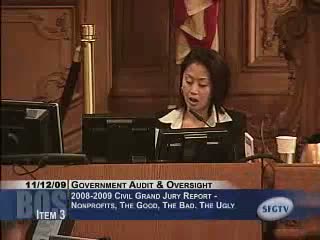
The Government Audit & Oversight Committee heard a civil grand jury report assessing San Francisco’s nonprofit contracting, procurement and the budget practice known as targeted add‑backs.
Leonard Kelly, a civil grand jury foreperson, told the committee the jury reviewed procurement, back‑office functions and program/performance monitoring and urged development of a citywide system to track fiscal and program outputs across grants and contracts. The jurors recommended discontinuing the practice of targeted add‑backs, which they said can reallocate funds late in the budget process without sufficient administrative coordination.
The mayor’s office (Kate Howard) said the administration is following the grand jury’s recommendations through a community‑based organization (CBO) task force and related work led by the city attorney and nonprofit leaders. Departments, including the Department of Public Health (Barbara Garcia), the Office of Contract Administration (Galen Leon), the Controller’s Office (Catherine Spalding) and the Department of Children, Youth and Their Families (Maria Sue), described efforts to improve joint fiscal monitoring and noted DCYF’s CMS as a possible model for wider use.
Nonprofit leaders and networks urged the board to build on existing task forces and coordinated implementation rather than create duplicative bodies. Speakers from the Human Services Network and several nonprofit contractors emphasized consolidating back‑office functions, sharing purchasing power and tying grants to outcome measures that reflect impacts on priorities such as truancy or homelessness.
The committee debated which findings the board must formally respond to and which are executive branch matters. Committee staff identified several findings and recommendations that fall under the mayor’s administration; the board agreed to amend responses accordingly. On the record the committee filed item 3 and moved item 4 for further action and incorporation of department responses.
Public commenters called for better tracking of grants (especially non‑city grants) and for performance measures that assess impact rather than activity counts. The grand jury and stakeholders agreed on the need to reduce administrative burden on nonprofits while improving fiscal oversight and outcome measurement.
The committee’s action will be recorded in a resolution that incorporates departmental responses and next steps for follow‑up.