Get Full Government Meeting Transcripts, Videos, & Alerts Forever!
Get email alerts on the Housing topic
No spam. Unsubscribe anytime.
San Francisco committee delays vote on ordinance defining intermediate‑length occupancy after planning staff warn of enforcement, eviction risks
Summary
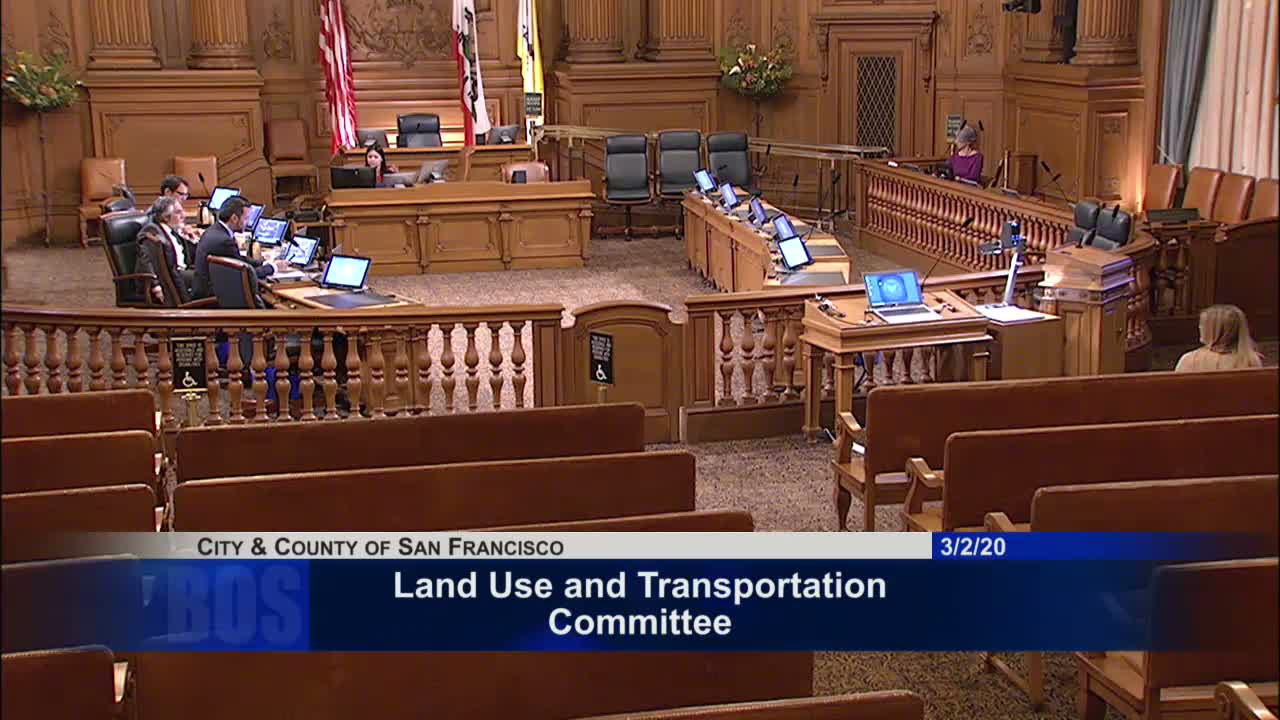
The Land Use and Transportation Committee on March 2, 2020, continued an ordinance to add an "intermediate‑length occupancy" (ILO) use to the planning code after Department of City Planning staff said enforcement could risk evictions and the department lacks authority over private lease terms; the chair directed stakeholder meetings and said amendments will return next week.
The Land Use and Transportation Committee of the San Francisco Board of Supervisors on March 2, 2020, continued consideration of an ordinance to create an "intermediate‑length occupancy" (ILO) residential use in the planning code after planning staff raised enforcement and scope concerns.
Diego Sanchez of the Department of City Planning told the committee the planning commission recommended placing interim controls on ILO activity to give the city time "to gather data on ILO, as well as to hammer out a complete and consistent set of permanent controls." Sanchez said the draft ordinance "lacks an explicit ILO in buildings with 9 dwelling units or less — to quote unquote register and legalize and count against the ILO cap limit," and warned that enforcement might require resources the department does not have.
Sanchez also cautioned that enforcement could trigger evictions in zoning districts that prohibit ILOs: "There is a possibility that enforcement leads to evictions when ILO is being done in a zoning district that prohibits it," he said, and questioned whether the planning department has authority to regulate private lease provisions intended to restrict occupancy by anything other than a natural person.
The committee chair (name not stated) acknowledged those concerns and outlined specific areas that need refinement, including the proposed 25% cap, how existing ILOs in pre‑1979 housing should be treated, and the ordinance's treatment of buildings with fewer than 10 units. The chair said some lease‑related issues may fall under the Rent Stabilization and Arbitration Board and proposed convening meetings "with city attorneys present and my competent staff present" and inviting planning staff, rent board representatives and tenant advocates to work through outstanding issues.
"I intend to come back hopefully next Monday with a set of amendments that deal with the cap, that deal with pre existing ILOs in pre‑nineteen 79 housing and deal with the, less than 10 unit issue," the chair said. The chair added that his policy intention is to let existing ILO arrangements expire rather than forcibly displace occupants.
After the exchange, the chair moved to continue Item 1 for one week; Supervisor Asha Safaei indicated support. The committee continued the item to the following week's meeting and adjourned.
Next steps: staff will convene the stakeholder meetings the chair described and the committee is expected to consider proposed amendments when the item returns. The clerk earlier noted items acted on by the committee will appear on the Board of Supervisors agenda on March 10 unless otherwise stated.