Get Full Government Meeting Transcripts, Videos, & Alerts Forever!
Get email alerts on the Ilo Legislation topic
No spam. Unsubscribe anytime.
Supervisors continue debate on "intermediate-length occupancy" ordinance after heated public comment
Summary
Supervisors heard hours of public comment on proposed legislation to define and regulate intermediate-length-occupancy (ILO) or "corporate rentals." The sponsor proposed a two-year legalization window limited to 1,000 units, conditional-use permitting for existing conversions, removal of a 501(c)(4) exemption, and a required Controller study; the committee adopted amendments and continued the item for further work.
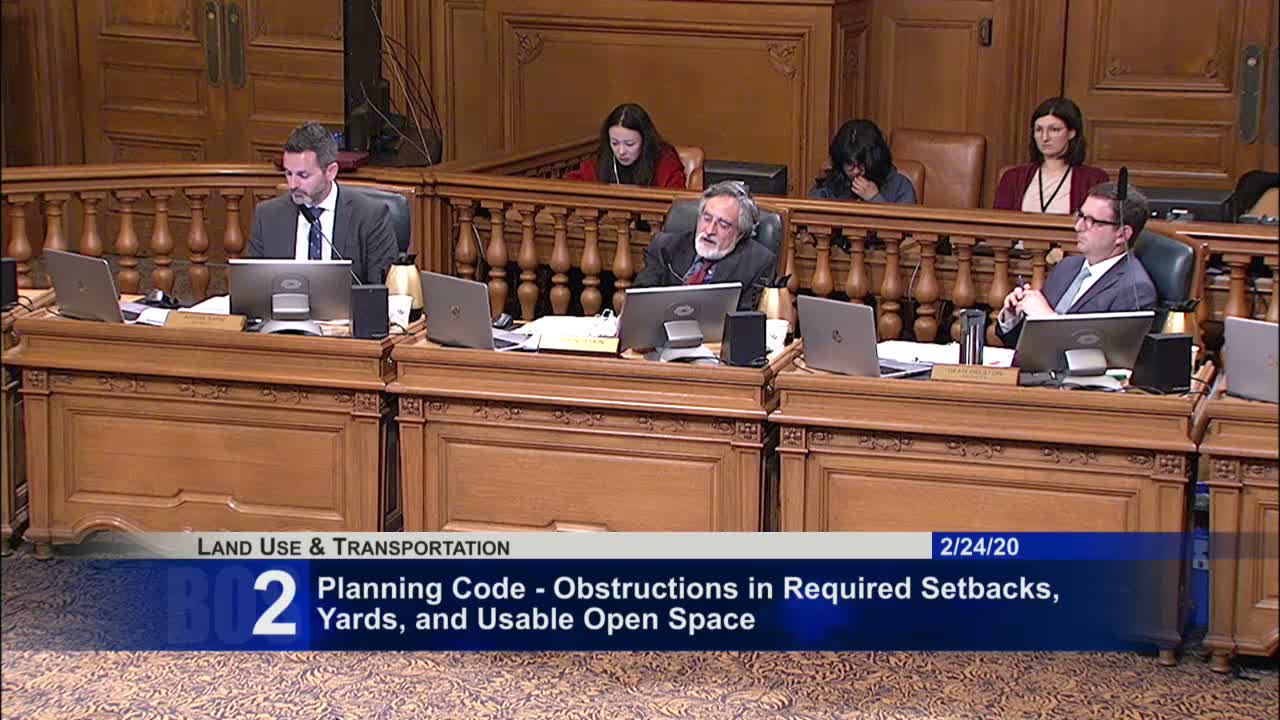
A broad and contentious hearing on an ordinance to define and regulate "intermediate-length occupancy" (ILO) housing — commonly described as corporate rentals or furnished intermediate-term units — consumed much of the committee's Feb. 24 meeting.
Sponsor Aaron Peskin framed the measure as an effort to preserve long-term housing while recognizing legitimate short-term needs (relocating workers, medical families, visiting artists). The ordinance would create a new residential-use characteristic for ILOs, amend the administrative code to limit non-tenant use of rental units for temporary occupancies, require a Controller study of impacts and nexus fees, and include an initial cap that Peskin said would legalize up to 1,000 units over two years as operators come into compliance through a conditional-use (CU) process.
Fred Brussell of the Budget & Legislative Analyst told the committee that the city lacks robust data on ILOs; BLA estimated conservatively that at least 2,000 units exist in San Francisco based on provider listings and trade-association information but cautioned that provider self-reporting varies. Brussell provided examples of rates and occupancy from national and local trade data (national average daily rate ~$161; a 2017 SF sample showed an average daily rate of $231 and an average length of stay roughly 71 nights).
Public comment filled more than an hour and showed deep divisions. Tenants and tenant-rights advocates argued that ILOs encourage the removal of rent‑controlled units from the long‑term market, incentivize renovictions, and constitute a speculative business model that undermines housing stability. Several speakers described buildings they said were being cleared or kept empty by firms such as Veritas; Veritas’ COO disputed those claims, saying the company renovates buildings and signs many long leases and that its stated aim is to restore rent‑controlled housing stock.
Industry representatives and smaller providers urged more flexible approaches: grandfathering for some large properties, percentage-based caps per building rather than a citywide hard cap, exemptions for nonprofit housing uses, and clearer definitions distinguishing furnished housing for individuals (travel nurses, medical patients) from corporate leasing models.
After discussion the sponsor distributed two amendments — removing a 501(c)(4) exemption and clarifying that the ILO designation applies to non-price-controlled (post‑1979) units and certain new construction — and moved to adopt the amendments and continue the item to the next meeting so the Board and Planning Commission can further develop CU criteria and data-collection requirements. The committee approved the amendments and continued the legislation without objection.
Next steps: staff will prepare amendments and CU criteria, the Controller will proceed with a requested nexus and scale study, and the item will return for additional hearings.