Get Full Government Meeting Transcripts, Videos, & Alerts Forever!
Get email alerts on the Housing Conservatorship topic
No spam. Unsubscribe anytime.
Supervisors press DPH as housing conservatorship paperwork cleared but no cases filed
Summary
San Francisco officials pressed the Department of Public Health on why the city has not yet used the narrow housing conservatorship allowed under 'SB 10 45.' DPH said court pleadings were finalized last week and notices to people who hit five 5150 holds have begun; supervisors pressed for bed counts and timelines for filing petitions.
San Francisco supervisors pressed city health officials on the city's stalled rollout of the housing conservatorship authorized in the state statute identified in the transcript as "SB 10 45," after Department of Public Health leaders said the court paperwork needed to file petitions was only finalized last week.
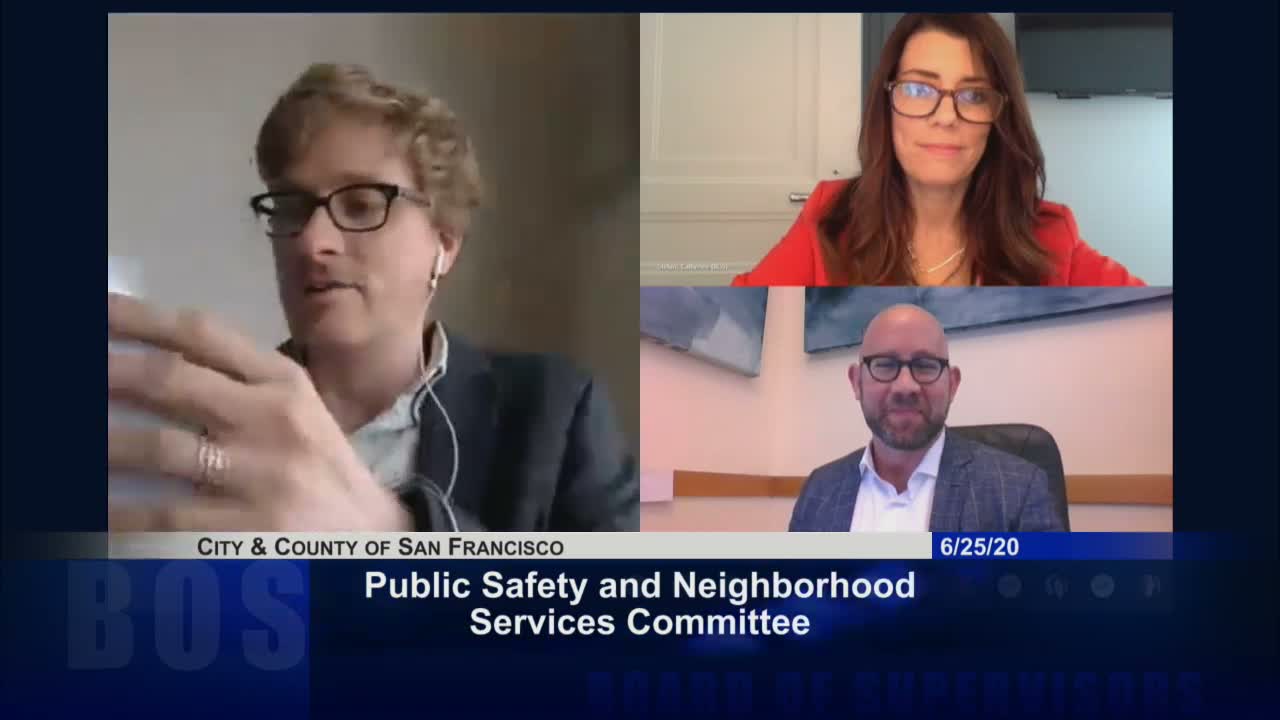
"More than a year after this hard fought battle to locally expand conservatorships was won, I am perplexed, very, very, very perplexed, that not a single person in San Francisco has been conserved under this new law," Supervisor Rafael Mandelmann said at the Committee's June hearing on the Housing Conservatorship Preliminary Evaluation Report. Mandelmann, who chairs the Public Safety and Neighborhood Services Committee, requested the update to understand implementation barriers.
The department's lead presenter, Angelica Almeida, director of Forensic and Justice-Involved Behavioral Health Services at the Department of Public Health, summarized months of cross-agency work and said the key obstacle was completing court-approved pleadings. "I am happy to report that as of last week this paperwork has been approved, and so we are now able to move forward with filing paperwork with the court," Almeida said.
Almeida described the conservatorship as a narrow, last-resort option for a small number of people with severe mental illness compounded by substance use who repeatedly cycle through crisis services. She told supervisors the department used coordinated data to estimate the population: about 3,800 unique individuals experienced a 5150 hold in fiscal year 2018–19 (about 5,851 total holds), and a subset of roughly 117 people seen at psychiatric emergency services recorded four or more 5150 holds that year — a group the working group identified to study as potentially on a pathway to conservatorship.
Deputy City Attorney Anne Pearson described the court collaboration: "the parties feel that ... our office feels we are ready to bring a case as soon as there is an individual who meets all of the eligibility criteria," she said, stressing that the court required explicit findings be met for each petition.
Supervisors repeatedly pressed DPH and partner offices for concrete capacity figures and near-term timelines. Mandelmann and others said judges will likely ask whether the city can provide appropriate placement and step-down options before approving conservatorships; they called for clarity about the number and type of locked, subacute and residential beds that would be available for people after stabilization. Almeida said the conservatorship statute includes a temporary conservatorship of up to 28 days to allow inpatient stabilization and engagement with services but acknowledged that long-term placements and bed flow are constrained.
Public comment reflected a split in views: clinicians and family members described people who repeatedly cycle through crisis and urged using conservatorship for those unable to accept voluntary care, while many advocates warned that the 5150 process is driven by police involvement and that Black San Franciscans appear disproportionately represented among people with multiple holds. Caller Jennifer Estine, a psychiatric nurse who serves on the working group, urged caution about locked units and emphasized the need for housing and voluntary services; callers from community groups pressed for more beds, outreach, and better data from private hospitals.
Mandelmann said notices to people who reached five 5150 holds had begun and that the treating psychiatrist and hospital would initiate paperwork if an individual met criteria at a later threshold. He moved to continue the conservatorship hearing to the committee meeting on July 23 to review progress; the motion passed on a 3-0 recorded voice vote.
What happens next: DPH will continue outreach and monitoring, send notices to people who meet fifth-hold thresholds, and — according to Almeida — submit petitions to the court when an individual meets the statute's full eligibility criteria and treating clinicians support filing. The committee asked DPH to return with clearer bed-capacity numbers and a timeline for filings.