Get Full Government Meeting Transcripts, Videos, & Alerts Forever!
Get email alerts on the Procurement Policy topic
No spam. Unsubscribe anytime.
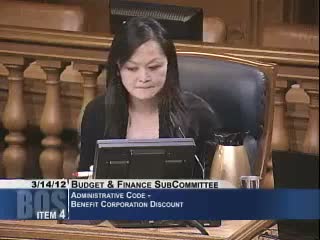
Committee advances amended measure on benefit-corporation contracting discounts; ordinance continued for further drafting
Summary
Supervisors debated an ordinance to grant bid preferences to state-recognized benefit corporations, agreed to reduce the discount to 4%, require HRC oversight and third-party verification, and continued the item to April 4 so staff can draft and model amendments and implementation detail.
The Budget and Finance Committee discussed an ordinance amending the San Francisco Administrative Code to grant limited contracting preferences to California benefit corporations and agreed to a package of amendments before continuing the item for further drafting and analysis.
Supervisor David Chu introduced the ordinance and described benefit corporations as businesses that formally adopt a public-benefit purpose and report on social and environmental performance. Chu said he sought a contracting preference modeled on the city's Local Business Enterprise program but narrowed the proposal after stakeholder feedback.
Committee debate focused on several implementation concerns: the appropriate size of the bid discount, how to verify public-benefit claims, risks that a nonlocal or large corporate subsidiary could exploit status to displace local vendors, and potential administrative burdens for the purchasing office. Key changes the committee agreed to in principle included reducing the bid discount from the initially proposed 8 percent to 4 percent, eliminating an additive preference for LBEs that are also benefit corporations, limiting the preference to contracts under $10 million, requiring six months' benefit-corporation registration before eligibility, mandating third-party verification of public benefit, and assigning oversight responsibility to the Human Rights Commission (HRC) with periodic monitoring (every six months for the first two years, then annually).
The budget analyst cautioned that fiscal impacts remain uncertain because the universe of companies that would seek benefit-corporation status and city contracts is unknown; an illustrative calculation for construction contracts suggested possible costs in the hundreds of thousands of dollars but did not represent a definitive fiscal impact. The Office of Contract Administration asked for additional time to model implementation impacts across commodity types and to consider interactions with other procurement rules, such as sweatfree requirements.
Public comment was sharply divided: the California Association of Nonprofits opposed the discount as an unwarranted privilege lacking demonstrated benefit to San Francisco, while multiple local B-corp business founders and trade groups argued the preference would encourage socially responsible businesses to locate and bid in San Francisco.
The committee moved to take Supervisor Chu's amendments (including two additional concepts to be drafted with the City Attorney), directed staff to circulate language, and continued the ordinance to April 4 for further review and modeling before it returns to committee. The item will return with clearer language and implementation analysis.
Next steps: City Attorney to draft the two outstanding amendments; HRC and Office of Contract Administration to provide implementation guidance and modeling; committee reconvenes on April 4 for further consideration.