Get Full Government Meeting Transcripts, Videos, & Alerts Forever!
Get email alerts on the Telecom Regs topic
No spam. Unsubscribe anytime.
Committee delays implementation of wireless small-cell rules after broad public concern over health, notice and aesthetics
Summary
After extensive public comment on ordinance 190.19, supervisors agreed to continue consideration so the city attorney and Public Health can update guidance; speakers raised health-risk claims, notice and appeal concerns, and urged a March litigation-based pause.
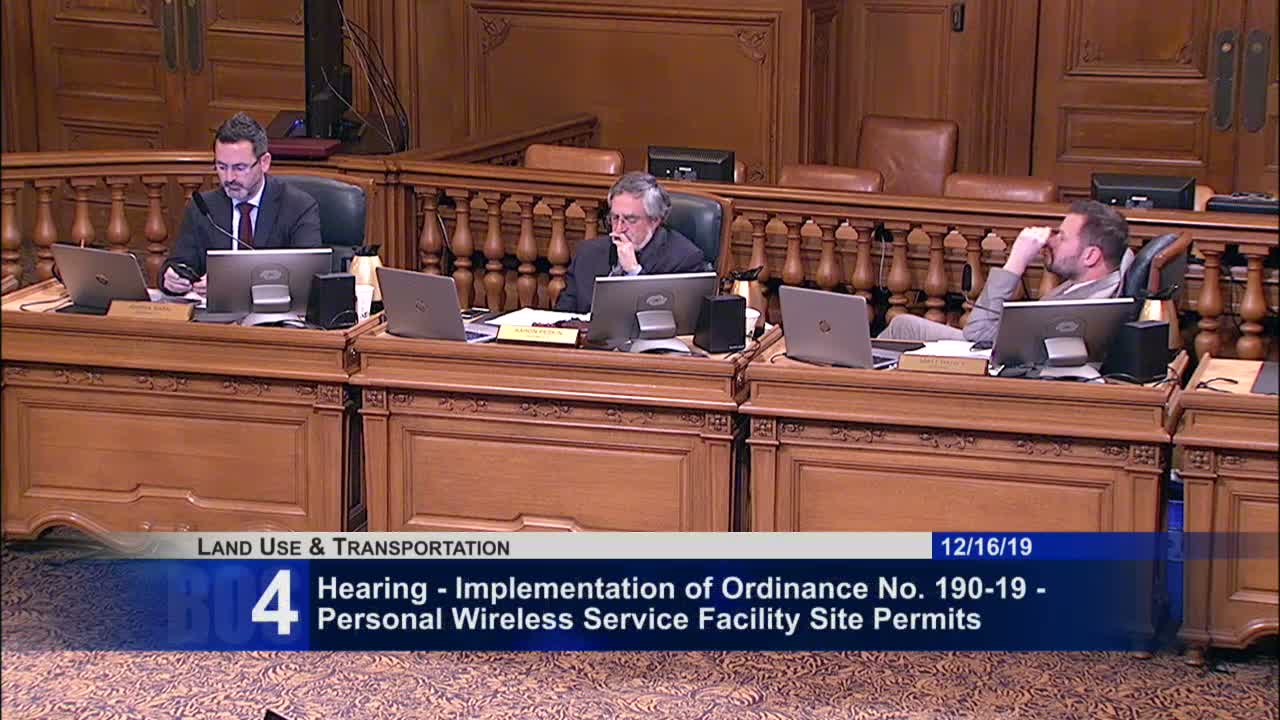
The committee opened a hearing on Item 4: implementation of ordinance 190.19 regarding personal wireless service facility permits and small-cell installations. Chair Aaron Peskin emphasized the legal constraints posed by federal and state preemption as well as the city's interest in protecting public health, aesthetics, privacy, and local design standards.
Public comment was lengthy. Multiple speakers urged delaying implementation until pending court decisions and Public Health's updated review are available. Charlotte Halifax urged waiting until March 15 for appellate rulings she said could affect the FCC's authority; she requested the ordinance be vacated if the court ruled in the petitioners' favor. Several speakers raised concerns about notice and appeals procedures and said residents frequently learn of installations only through public records requests rather than timely notice.
Health-related claims were offered by several commenters. Dr. Thomas Cowan said published analyses show higher childhood cancer rates close to Sutro Towers and warned that 4G/5G rollout "will dramatically increase the disease rate in the population of San Francisco." Linda Smith and others urged enforcement of radio-frequency emission testing and cited the city's 2003 Precautionary Principle ordinance. Other speakers asked for liability protections, indemnification, and insurance from carriers.
Public Works staff said the department implemented a process in September to meet the FCC 'shot clock' and that the department will pause adoption of objective standards at the committee's direction. Staff confirmed a posting requirement remains for PG&E poles, while PUC and MTA poles follow their own processes. Chair Peskin moved, without objection, to continue Item 4 to the call of the chair so the city attorney and Public Health can provide updated legal and health analyses; the committee also agreed to hold off on adopting objective standards until that work is completed.