Get Full Government Meeting Transcripts, Videos, & Alerts Forever!
Get email alerts on the Overdose Crisis topic
No spam. Unsubscribe anytime.
Supervisors declare a public‑health crisis on overdoses; advocates urge rapid rollout of naloxone, sobering centers and supervised consumption
Summary
The committee forwarded a resolution declaring a public‑health crisis on drug overdoses and urged the Department of Public Health to submit an emergency response plan. DPH described naloxone expansion, syringe access, mobile outreach, and short‑ and long‑term steps; community speakers repeatedly urged supervised consumption/safe injection sites and criticized encampment sweeps.
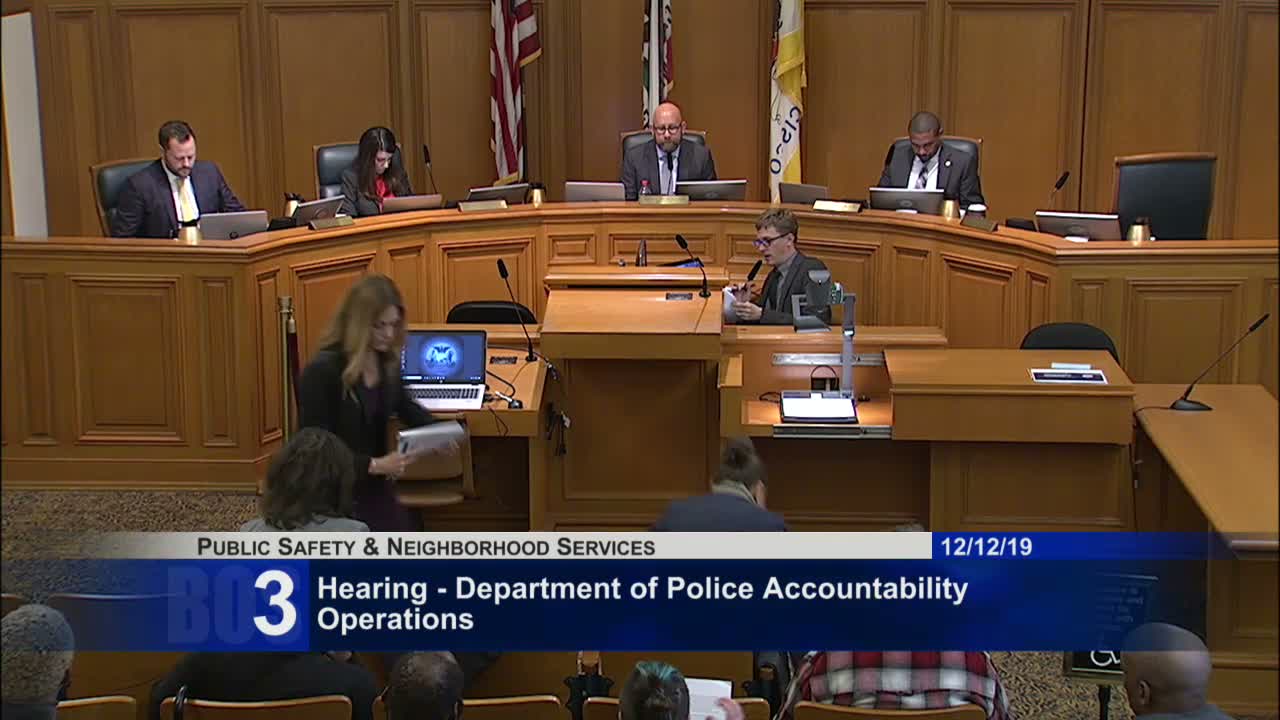
The committee unanimously moved to forward to the full Board a resolution that declares a public‑health crisis on drug overdoses and asks the Department of Public Health (DPH) for a comprehensive emergency response plan.
Supervisor Matt Haney opened the hearing by describing a rising overdose toll (259 overdose deaths in 2018, and a 150 percent increase in fentanyl deaths in 2018) and asking DPH to address seven areas: outreach and response to people in psychosis or at risk of overdose, naloxone access, data‑driven deployment of outreach, regular public reporting, frontline responder support, emergency detox and drop‑in facilities, and pursuit of state or federal support.
DPH presenters (Eileen Loughran, Dr. Philip Coffin and Dr. Judy Martin) said San Francisco has a long‑standing harm‑reduction approach and several existing programs — syringe access and disposal, naloxone distribution (DOPE Project), mobile health fairs, low‑barrier buprenorphine and the sobering center — and that recent increases in overdose deaths are driven largely by fentanyl. They described actions under way or planned: an overdose‑alert system coordinated with community partners, a de‑identified data feed to DataSF for public dashboards, expansion of naloxone distribution and Project Friend (first‑responder naloxone distribution and training), work to establish a drug sobering center and SRO overdose prevention pilots, expanding dual‑diagnosis beds and behavioral health access under Mental Health SF, and efforts to lower intake barriers for treatment.
Community speakers — including representatives from the DOPE Project, San Francisco AIDS Foundation, GLIDE, St. Anthony’s, Drug Users Union, Coalition on Homelessness and others — overwhelmingly urged faster, larger responses and demanded supervised consumption/overdose prevention sites, more peer‑based outreach, treatment on demand, multiple sobering centers, and an end to sweeps that disperse communities and, they said, increase overdose risk. Several speakers recounted rescuing and reversing overdoses on the streets and said peer responders and harm‑reduction programs have been the primary reason the city avoided larger death counts to date.
Supervisors asked for follow‑up metrics (street engagement frequency, service capacity), more rapid timelines for overdose prevention sites, and better real‑time data on overdose clusters. Chair Rafael Mandelmann moved to forward Haney’s resolution with a positive recommendation to the full Board; the motion carried without objection.