Get Full Government Meeting Transcripts, Videos, & Alerts Forever!
Get email alerts on the Secondhand Smoke topic
No spam. Unsubscribe anytime.
Board hearing spotlights health harms from drifting secondhand smoke and enforcement gaps in multiunit housing
Summary
UCSF and DPH experts described health harms from tobacco, e‑cigarette aerosol and cannabis smoke and pilot results showing voluntary smoke‑free homes can increase cessation; supervisors signaled intent to explore legislation while emphasizing protections against eviction or punitive enforcement.
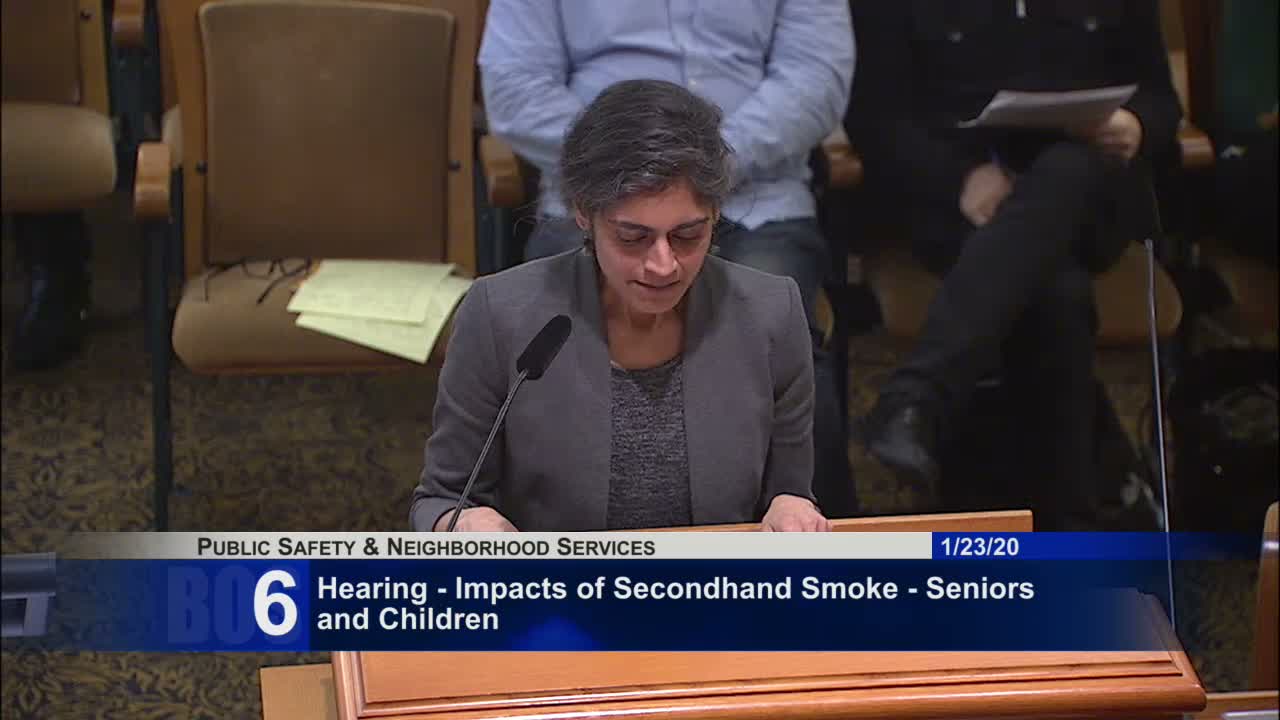
At the Jan. 21 Public Safety & Neighborhood Services Committee hearing, UCSF researchers and San Francisco Department of Public Health staff presented evidence on the health impacts of secondhand smoke—cigarette smoke, e‑cigarette aerosol and cannabis smoke—and explained local policy and enforcement gaps related to multiunit housing.
Dr. Maya Vijayaraghavan of UCSF summarized research showing secondhand exposure increases risks for lung and heart disease, highlighted disparities (African American children had higher exposure in cited studies), and described a pilot in supportive housing where voluntary smoke‑free home adoption rose from 12% to 31% at six months and self‑reported cessation increased among participants. She noted barriers including nicotine dependence, enforcement concerns and staffing for cessation services.
Alice Hu Wen of DPH’s Tobacco Free Project reviewed San Francisco data and rules: Health Code sections (described in the hearing as Health Code 19F) prohibit smoking in common areas of multiunit housing; the 2013 disclosure ordinance (referred to in testimony) requires managers to indicate whether units permit smoking. State law (Senate Bill 322) allows property owners to designate smoke‑free units in leases. Jen Calleward (Environmental Health) explained enforcement mechanics: the city can require building managers to post no‑smoking signage and issue tenant notifications but generally cannot evict or issue tickets to individual residents for smoking inside their private units; complaints largely route through 311 and Tobacco Free Project outreach.
Speakers from advocacy groups (Americans for Nonsmokers’ Rights, American Cancer Society, San Francisco Tobacco Free Coalition) and residents urged the Board to expand smoke‑free protections for multiunit housing to reduce drifting exposures that harm children, seniors and low‑income residents. Supervisors praised the presentations and public testimony; President Yee said he plans to explore legislation to expand protections, and Supervisor Walton cautioned that enforcement should not enable predatory evictions or tenant displacement.
The committee 'heard and filed' the presentations, leaving policy design, enforcement language and tenant‑protections for follow‑on work with DPH and City Attorney guidance.