Get Full Government Meeting Transcripts, Videos, & Alerts Forever!
Get email alerts on the Overdose Reporting topic
No spam. Unsubscribe anytime.
Supervisors push for timelier overdose data as fentanyl deaths spike
Summary
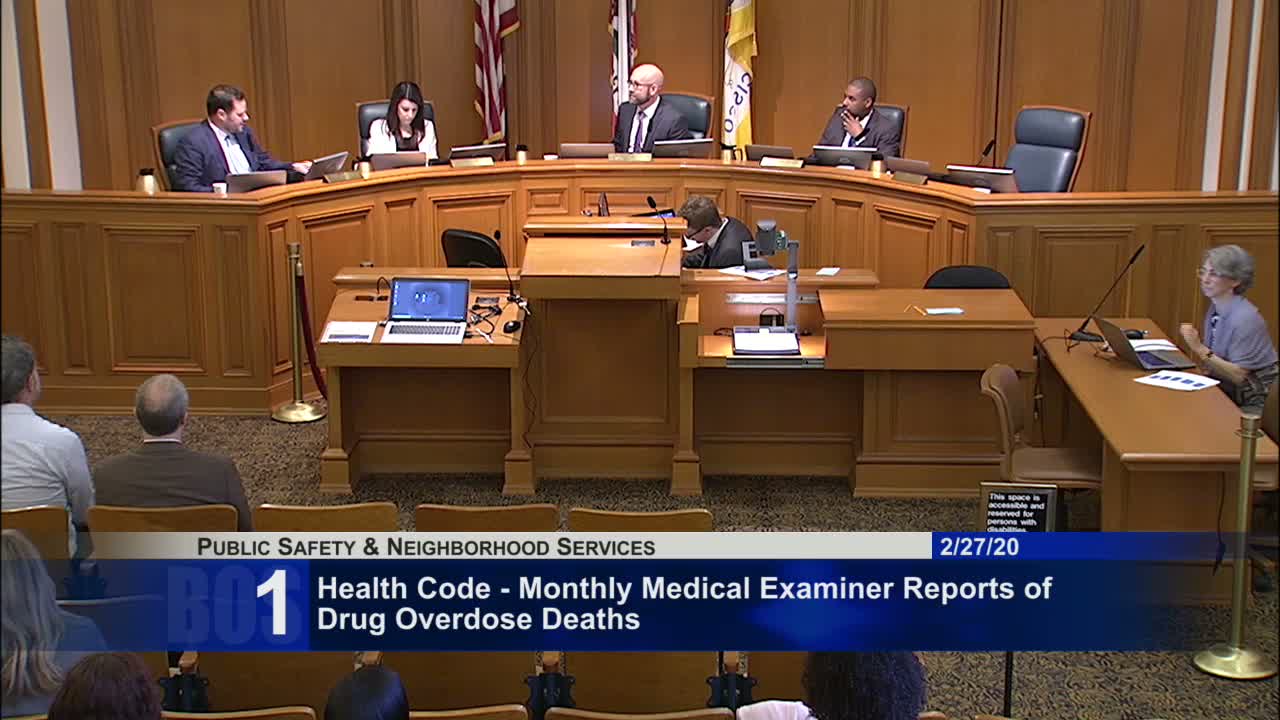
The Public Safety and Neighborhood Services Committee advanced amendments to a bill requiring more frequent public reporting of overdose mortality data after hearing Department of Public Health explanations about case-closure delays and testimony on rising fentanyl deaths.
Supervisor Matt Haney proposed legislation to make mortality data on drug overdoses more timely, saying San Franciscorecorded 222 overdose deaths in 2017, 259 in 2018 and at least 330 in 2019 and that fentanyl-related deaths surged. Haney told the committee the goal is to provide policymakers, public-health officials and service providers with up-to-date information so they can respond in near real time.
Haney said initial language had required monthly reporting from the chief medical examiner, but that conversations with medical-examiner staff indicated a large share of cases require weeks to close. "Weare amending our legislation to reflect reporting every four months," he said, arguing that interval balances timeliness with the forensic work needed to attribute causal drugs accurately.
A Department of Public Health presenter outlined why mortality counts lag: death-scene investigation, autopsy and toxicology can take months and cause-of-death attribution is complex. The presenter said early data pulls capture only a small share of deaths (roughly 4% in the immediate month) while a four- to six-month window captures most confirmed cases, and cautioned that partial counts are easily misread as declines.
The hearing also included scientific and community perspectives. Dr. Rota, the chief forensic toxicologist quoted in the hearing, said the office was reluctant to wait six months "for reports" but recognized the need for accuracy and timeliness. Alex Crowell, an epidemiologist at RTI International, described long-term local work on naloxone distribution and said supervised overdose-prevention sites have been effective at connecting people to medication-assisted treatment.
Vice Chair Stephanie urged that surveillance be paired with stronger prevention, recovery and treatment efforts, saying reporting on deaths alone will not reduce fatalities. Committee members discussed the risks of releasing partial or estimated counts and whether the city should require the medical examiner to produce monthly, quarterly or four-month aggregate reports.
Chair Rafael Mandelmann moved to forward Supervisor Haneyamendments to the full Board of Supervisors with a positive recommendation, and the committee took that action without objection. The full board will receive the amended ordinance for further consideration.
The committee's next steps: the amendments will be forwarded to the full Board of Supervisors for consideration; the medical examiner and DPH may refine operational definitions and timelines if the ordinance advances.