Get Full Government Meeting Transcripts, Videos, & Alerts Forever!
Get email alerts on the Subacute Care topic
No spam. Unsubscribe anytime.
Supervisors press hospitals and DPH for rapid action as city grapples with subacute‑care bed shortfall
Summary
Supervisors heard a multi‑hour presentation from the Department of Public Health and patient advocates on an urgent shortfall of subacute SNF beds in San Francisco; DPH identified potential sites (Chinese Hospital 23 beds; San Francisco Healthcare up to 38), estimated an annual operating shortfall of roughly $3.5–4 million, and the committee continued the matter for follow‑up at the chair’s call.
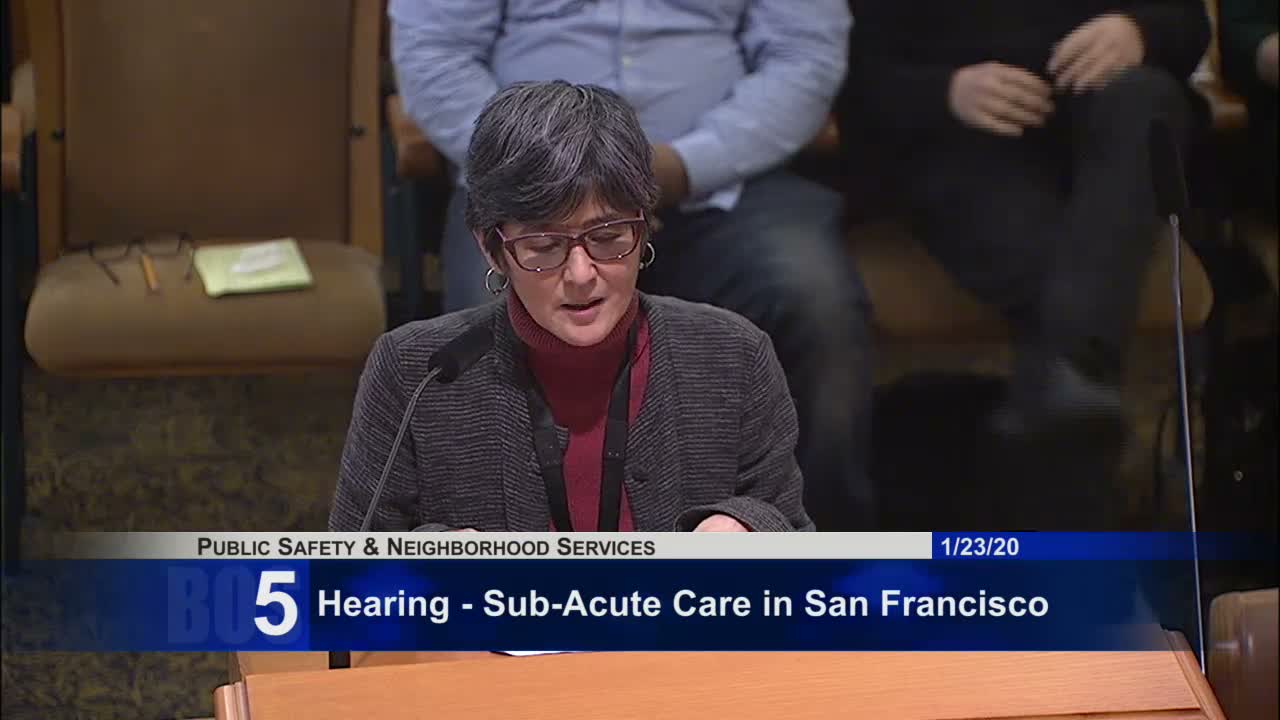
The Board of Supervisors’ Public Safety & Neighborhood Services Committee spent the bulk of its Jan. 21 meeting on subacute skilled‑nursing (SNF) capacity after hearing presentations from the Department of Public Health, hospital leaders, patients’ families and community advocates.
Supervisor Ahsha Safai opened with a recounting of the months‑long effort to prevent San Francisco from losing all in‑city subacute beds after closures at St. Luke’s; he described families who must travel far to see loved ones and said the city’s near‑term target should be roughly 80–90 subacute beds. Supervisor Walton, who visited the Davies campus, said she was “appalled” by the prospect that hospitals might focus on closing beds rather than preserving care.
Kelly Hiramoto, special projects director at DPH, presented the department’s SNF subacute project: DPH has engaged hospitals and freestanding SNFs (Kaiser, Chinese Hospital, Dignity/St. Mary’s, Vibra/Canfield, CPMC, UCSF, SFGH and several community providers). Chinese Hospital has a 23‑bed unit that could be converted for subacute use pending California Department of Public Health (CDPH) licensing and food‑service arrangements; DPH also reported San Francisco Healthcare & Rehabilitation is planning a phased conversion that could yield up to 38 subacute beds in the community.
DPH said Milliman Group modeling shows an operating reimbursement gap driven by Medicare and Medi‑Cal rates that may create an annual shortfall in the range of roughly $3.5 million to $4 million if hospitals operate the units; DPH is discussing potential offsets including bed purchases or lump‑sum contributions from partnering hospitals (Kaiser, UCSF, Sutter and Zuckerberg SFGH signaled willingness to support operations in concept). DPH emphasized remaining uncertainties: whether Chinese Hospital will self‑operate the unit or contract operations, resolving kitchen/food‑service compliance with CDPH, and establishing a staffing model.
Family testimony stressed urgency. Raquel Rivera described her sister Sandy, a 55‑year‑old subacute patient with a tracheostomy whose care and quality of life she said suffered after transfers; Rivera noted only eight subacute patients remained at Davies and asked the city to secure permanent in‑city capacity. Multiple advocates and labor groups called on CPMC to restore permanent beds at its facilities and urged the city to use leverage in future approvals.
Supervisors repeatedly pressed DPH on counts and demand estimates. DPH said prior work produced an estimated range of 49–90 residents discharged to subacute care, with a 2018 discharge count nearer to 70; the department acknowledged that tracking is imperfect because hospitals do not uniformly identify this population and pledged improved counting once in‑city bed destinations exist. DPH said it will ask hospitals to track the distinct subacute population to produce better demand estimates.
Given the outstanding questions and the urgency families described, Chair Mandelman agreed to continue the matter to the call of the chair and requested a status update within roughly 90 days. The committee did not take a formal funding action at the hearing; DPH said it will continue to work with Chinese Hospital, freestanding SNFs and hospital partners to resolve licensing, kitchen and operating models and to refine cost estimates.