Get Full Government Meeting Transcripts, Videos, & Alerts Forever!
Get email alerts on the Americas Cup topic
No spam. Unsubscribe anytime.
Supervisors press for stronger guarantees, local-hire rules as America's Cup deal advances
Summary
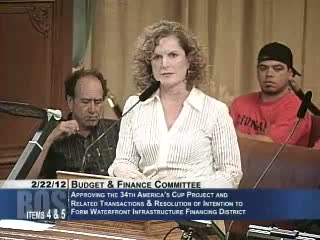
After weeks of negotiation, San Francisco's Budget and Finance Committee advanced the city's development agreement for the 34th America's Cup to the full Board with conditions but without a firm numerical cap on port reimbursement, while pressing for clearer fundraising guarantees and enforceable local-hire language.
San Francisco's Budget and Finance Committee voted to send the city's revisions to the America's Cup development agreement to the full Board of Supervisors, after weeks of negotiations produced a string of compromises on how the port's infrastructure costs would be repaid and how private fundraising would be guaranteed.
The committee's decision followed a long hearing in which Port staff, city budget and economic-development officials, the America's Cup organizing committee (ACOC) and the event authority described changes aimed at protecting the Port of San Francisco's finances while keeping the event viable. The Port has agreed to remove long-term development rights for Pier 29 from the reimbursable waterfall and instead accept a $12.3 million cash-equivalent placeholder or other port-approved replacement, officials said.
Mark Buell, chair of the ACOC, told supervisors the private fundraising effort has produced pledges of $12.5 million so far and that the committee is prepared to deliver near-term cash for city bills. "I will stand here today and commit to you that you will have between 9 and 9 and a half [million dollars] that you'll have in the city coffers to pay the bills that otherwise would be spent by the taxpayers," Buell said, committing to cash availability by June 30.
ACOC and the Local Organizing Committee also agreed to formalize a memorandum of understanding laying out how pledged sponsorships and advances will be collected and used. Keri McClellan, CEO of the Local Organizing Committee, said the $8 million sponsorship advance cited in the host-and-venue agreement is an advance on anticipated commissions and not guaranteed new sponsors: "It's an advance on our commission," she said.
Supervisors repeatedly pressed for firmer protections. Several said a numerical cap on the port's reimbursement obligation would be preferable but acknowledged the difficulty of setting a single aggregate number today, because the authority may build and recover costs over a decade. The city attorney called the alternative a "functional cap": a legal limit that restricts reimbursement to a defined sequence of revenue sources (rent credits, IFD proceeds, identified lease streams) and denies the authority other city funding channels.
Deputy City Attorney Joanne Sakai said that structure limits the Port's exposure by confining repayment to the enumerated sources: "The structure in section 1.5 provides a functional cap because it limits to exclusive sources the means by which the authority can be repaid," she said.
Event Authority director Stephen Barclay argued that the authority already has conceded substantially from earlier terms that allowed recovery of actual costs without limits. He warned that asking for still more concessions risked undoing the deal that brought the Cup to San Francisco: "We brought the America's Cup to San Francisco on the basis of the deal done; we are very, very uncomfortable with changing the deal now," he said.
On workforce provisions, the event authority and the city's Office of Economic and Workforce Development (OEWD) presented a revised workforce plan that would require contractors to meet trade-by-trade targets (for example, 20% of construction hours to San Francisco residents and specific apprentice targets) and allow OEWD to assess penalties and require contributions to training pipelines if contractors fall short. City staff indicated they will continue to work with unions and the authority to align penalties and enforcement with San Francisco's local-hire policies.
Supervisors also sought clearer fundraising milestones. The Local Organizing Committee agreed in writing to secure $12 million in receipts by June 30 as part of the MOU, language officials said they will refine and deliver before the full Board meets.
The committee voted to forward the DDA and the IFD resolution to the full Board without recommendation, while directing staff to return revised MOU and DDA language that reflects the committee's points of emphasis (functional reimbursement waterfall, Pier 29 treatment, clarified fundraising commitments and stronger workforce enforcement) before that vote.
Next steps: the Board of Supervisors will consider the revised DDA and related resolutions at its next meeting, and port staff and the event authority will continue negotiating the specific legal language. If the Board approves, the Port and event authority will still need to complete environmental and permitting steps with regional regulators, including BCDC, before many long-term financing decisions are final.