Get Full Government Meeting Transcripts, Videos, & Alerts Forever!
Get email alerts on the Americas Cup topic
No spam. Unsubscribe anytime.
Supervisors press for tougher caps, clearer fundraising and local‑hire guarantees in America's Cup DDA
Summary
After nearly six hours of testimony, the Budget & Finance Committee agreed to remove a controversial seawall lot from the proposed Port IFD and to continue discussion of the America's Cup Development and Disposition Agreement so staff can negotiate stricter cost controls, clearer fundraising guarantees and stronger local‑hire and arts commitments.
San Francisco
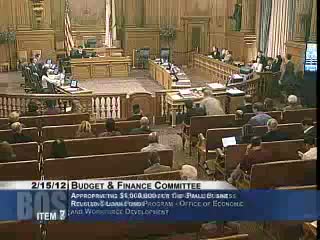
The Budget & Finance Committee on Tuesday delayed final approval of the America's Cup Development and Disposition Agreement (DDA) and related Infrastructure Financing District (IFD) resolution, instructing city staff to return with tighter financial protections after a full day of testimony and analysis.
Committee members praised the potential legacy—rehabilitated waterfront piers, an accelerated cruise‑terminal schedule and new public access—but said rising cost estimates, uncertain fundraising and unclear repayment terms leave the city and the Port exposed.
Why it matters
The DDA would allow the America's Cup Event Authority to fund major pier repairs and a set of port improvements that event planners say are necessary to host advance races in 2012 and the Cup matches in 2013. Port staff and the Event Authority have estimated roughly $111 million in reimbursable improvements for 2012–2017, with a large concentration of cost at Piers 30–32. Under the agreement, the authority would recover actual expenditures through a specified “waterfall” of interim rents, IFD proceeds, future long‑term leases and other rights; any unpaid balance would accrue interest at 11 percent annually.
What supervisors asked for
Several supervisors urged changes the committee wants port and event negotiators to pursue before returning the DDA for a final vote:
- A practical cap or functional limit on total reimbursable authority infrastructure expenditures and clearer third‑party cost review instead of open‑ended reimbursement based only on actual bills; supervisors suggested a notional cap (discussion ranged around $75 million) as a negotiation target.
- Tighter guarantees that the organizing committee's fundraising will match the city’s cash‑flow needs; staff was directed to return with a memorandum of understanding (MOU) laying out a quarterly schedule of expected payments or encumbrances, and mechanisms to reduce general‑fund exposure.
- Stronger participation by the port in future proceeds (for example, resale or transfer proceeds from condominium sales or major property transfers) to ensure the Port shares in long‑term upside from development rights granted to the authority.
- Clearer commitments on local‑hire, prevailing‑wage compliance and a plan to incorporate a city‑run arts and neighborhood engagement program so event spending benefits more neighborhoods, not just the waterfront.
Claims and fundraising status
The America's Cup Organizing Committee (ACOC) and the Event Authority told the committee they have secured roughly $12.5 million in pledges and sponsorship commitments toward a three‑year fundraising goal; ACOC leaders said they expect to accelerate cash to cover city expenses by June 30.
"The reality is we've raised $12,500,000.0, so we've exceeded it," ACOC chair Mark Buell said during the hearing.
But the City Controller's office cautioned those amounts are pledges and payment schedules extending across three years, not all cash on hand, and therefore are not legally binding guarantees to meet near‑term city expenses. Controller Ben Rosenfield summarized his office's independent on‑site review: the organizing committee had roughly $800,000 in cash at the end of last year, and $12 million in signed pledges over a three‑year payment schedule. "Those do represent pledges...they are not binding legal commitments," Rosenfield said.
Budget Analyst recommendations and port responses
The Budget and Legislative Analyst (BLA) recommended several changes adopted by the committee as negotiation priorities: require third‑party cost estimates for major seawall and seismic work before the Port reimburses the Event Authority; consider a cap on reimbursable expenditures; restore participation language that would share some proceeds from future condo resales and large transfers; require earlier return of short‑term venues so the Port can re‑tenant and restore revenue; and escalate initial rent levels where long delays precede long leases.
Port staff said they have modeled the likely sources of repayment and presented a "practical cap" (an NPV calculation of available reimbursement streams) and asserted they will continue to negotiate risk‑allocation changes with the Event Authority. But port staff acknowledged the largest cost driver—the scope and cost of work at Piers 30–32—has grown materially since the original term sheet and remains a point of contention.
Public testimony and local concerns
More than a dozen neighborhood organizations, labor unions and arts groups testified. Supporters said the event could accelerate long‑stalled port capital projects and create tourist and vendor revenue for local businesses. Labor and community groups pressed for binding local‑hire and prevailing‑wage language in the DDA, and arts groups urged a city‑run cultural program to draw visitors into neighborhoods beyond the waterfront.
Next steps
The committee voted to remove Seawall Lot 351 (the so‑called 8 Washington site) from the Port IFD notice and to continue the DDA/IFD items to allow further negotiations. Staff were instructed to seek port and Event Authority agreement on the BLA's recommended protections, produce a draft MOU laying out a schedule of payments and encumbrances (quarterly), and return with a revised package and updated financial materials before the Board acts.
What to watch
Look for a revised DDA that incorporates cost caps or third‑party caps for major substructure/seismic work, a clearer repayment timetable tied to documented cash receipts, and specific local‑hire and arts festival commitments before a final Board vote.