Get Full Government Meeting Transcripts, Videos, & Alerts Forever!
Get email alerts on the Sharp Park Restoration topic
No spam. Unsubscribe anytime.
Board committee advances Sharp Park study to weigh golf, restoration and transfer options
Summary
The Government Audit and Oversight Committee advanced an ordinance directing Rec and Park to produce a plan, schedule and budget to evaluate three alternatives for Sharp Park — keep 18 holes, a modified golf footprint, or no golf — focused on restoring habitat for the California red‑legged frog and the San Francisco garter snake and aligning work with CEQA and federal consultations.
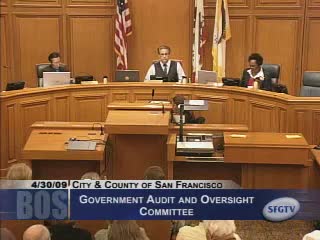
Chair Ross Mercurini said he put the proposal before the committee to break years of study and gridlock and to force a decision framework around finances, habitat and legal liability. “I am the person responsible for bringing this matter before us,” Mercurini said as he opened a meeting that drew a large public turnout.
Rec and Park staff described a three‑option approach they will analyze. “Basically, the 3 plans going forward would be the status quo, namely 18 hole golf course, a scenario where there's no golf whatsoever, and then a scenario where there's modified golf,” Jared Blumenfeld, Interim Director of Recreation and Park, told the committee. Blumenfeld and staff said the evaluation will be driven by two criteria: protection of the listed species in consultation with U.S. Fish and Wildlife and the California Department of Fish and Game, and the capital and ongoing maintenance costs of each option.
Natural‑areas staff outlined the ecological problem. Lisa Wayne, Natural Areas Program director, said Laguna Salata, Horse Stable Pond and connecting wetlands are critical breeding habitat for the California red‑legged frog and are used seasonally by the San Francisco garter snake, but that upland basking and refuge areas are currently limited and sedimentation and flooding are reducing open water. “The red‑legged frog breeds in the wintertime, where it produces these large grapefruit‑size egg masses of hundreds to thousands of eggs,” Wayne said as she described why stable water levels and upland habitat matter for recovery.
Staff gave known cost and schedule figures. Dawn Kamalathan, Rec and Park planning director and project manager for the exercise, said the department has an EIR contract in place: “Of the $722,000 that's being spent on the work associated with that EIR, about $413,000 is for Laguna Salata restoration work,” and she told supervisors the target date for completing the EIR process is September 2010. The department also described near‑term capital commitments already in motion: a recent outfall/seawall repair of roughly $245,000, a $1.5 million lead remediation at the rifle range, and a proposed recycled water project for the site with a total of about $8.6 million; staff said the San Francisco Public Utilities Commission's share would be about $6.9 million (roughly 78%) and about $1.9 million would be the North Coast Water District share.
Staff described interim measures already in place and a compliance plan to bridge to a full restoration effort. Blumenfeld said Rec and Park has implemented pumping protocols and other interim protections agreed with U.S. Fish and Wildlife; the department proposes additional steps including a 100‑foot monitoring zone around wetlands, biological monitors during mowing, restricting golf carts to paths, and eliminating inorganic fertilizers while longer‑term alternatives are evaluated. Blumenfeld noted an important regulatory consequence for the city: once a restoration plan is approved and followed, the city can be indemnified against accidental 'take' under federal law as long as it follows the plan’s procedures.
Public comment stretched for hours and illustrated the divide. Dozens of speakers urged immediate restoration to expand rare freshwater wetland habitat and to meet the city's obligations under the Endangered Species Act; environmental groups and scientists urged a science‑driven alternatives analysis and named the Golden Gate National Recreation Area (GGNRA) as a possible long‑term manager or partner. “Restoring Sharp Park is the most cost‑effective way to protect our coastline from climate change,” one pro‑restoration speaker said.
At the same time many golfers, Pacifica residents and senior citizens argued Sharp Park is a long‑valued, affordable municipal course whose closure would remove recreation for low‑income and senior players. Task‑force participants and local players said prior studies had favored retaining an 18‑hole layout or some hybrid options and warned that further study should not be biased.
Health, public‑safety and process concerns were also raised. A health professional urged the committee to evaluate mosquito‑control implications if wetlands expand; others asked for clear hydrology and geology work to account for sea‑level rise and erosion. Pacifica officials pressed for a formal seat in the process and suggested a multi‑agency working group including Pacifica, the North Coast Water District, the PUC, federal and state wildlife agencies and the GGNRA.
Committee direction and next steps: supervisors agreed to move the measure forward as a committee recommendation. Staff said the immediate objective is to quickly produce three professionally framed concept alternatives, refine them with agency input and public review, and then carry preferred alternatives into the CEQA EIR process. Rec and Park announced public EIR scoping meetings: May 12 in San Francisco (County Fair Building) and May 14 in Pacifica (Pedro Point Firehouse). The committee moved the item forward for a recommendation to the full Board to pursue the plan, schedule and budget study and to continue outreach to stakeholders.
What remains unresolved: no final policy decision was made at the committee; the department and regulators must complete Section 7 consultations under the ESA and Army Corps permitting for any hydrologic changes. The cost to implement full restoration or modified alternatives remains unknown and will be a central part of the departmental study.