Get Full Government Meeting Transcripts, Videos, & Alerts Forever!
Get email alerts on the Bayweb Project topic
No spam. Unsubscribe anytime.
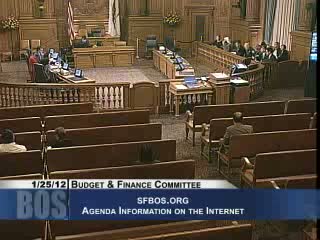
Budget committee continues Motorola site‑use agreement for Bay Area public‑safety broadband to get more cost and coordination details
Summary
The Budget & Finance Committee continued a resolution authorizing San Francisco to sign site access and use agreements with Motorola for the Bay Area 700 MHz public‑safety broadband network (BayWeb) for one week to get detailed cost, device and inter‑departmental coordination information; the JPA and NTIA grant create tight federal deadlines.
San Francisco27s Budget and Finance Committee voted to continue consideration for one week of a 12‑year site access and use agreement with Motorola that would let the city join the regional Bay Area 700 megahertz public‑safety broadband network known as BayWeb.
Chair Carmen Chu said the project offers clear regional safety benefits but raised concerns about long‑term device and operating costs and how BayWeb would overlap with other planned city radio investments. "We need to know what we're getting for free," Chu said, asking departments to return with detailed cost, coordination and COIT planning information.
Anne Kronenberg, director of the Department of Emergency Management, told the committee Motorola won an NTIA BTOP stimulus grant to build a regional system and that Motorola proposed significant private matching funds; she said the JPA and a BOOM (build‑own‑operate‑maintain) agreement are in place and that the federal grant requires two‑thirds of funds to be obligated by summer 2012 and completion by February 2013. "We have sites identified, we've walked the sites, and all we need to do at this point is purchase the equipment and get it installed," Kronenberg said.
Barry Frazier of DEM reviewed site flexibility and costs, saying staff estimates of direct city costs for the site‑use agreement fall in a range between roughly $3 million (department target) and $6.9 million (budget analyst27s conservative estimate) over the 12‑year term. DEM estimated about $92,000 in incremental costs in the current fiscal year for planning and permitting and projected electricity and other city costs over 12 years; Frazier emphasized lease payments are not authorized by the current site‑use agreement and would require separate Board approvals.
Harvey Rose, the budget analyst, flagged the larger unresolved expense: devices and monthly access fees to use the BayWeb system. Rose said the city has not estimated the number of devices departments would need and noted an access fee of about $43 per month per device in the department27s materials. "The large cost is accessing the system," Rose said; "the small cost is the site access agreement."
Public safety leaders urged moving forward because the network would allow regional sharing of mugshots, building floor plans and other time‑sensitive data during major incidents. Chief Sir described past events in which existing systems failed and said a dedicated public‑safety network would improve responder safety and field coordination.
Supervisors pressed DEM, the Department of Technology and COIT for a clearer plan showing how BayWeb would interact with a planned 800 MHz radio replacement (voice) and other agency IT priorities. The committee asked departments to work with the budget analyst and the mayor27s budget office to provide a long‑range estimate of device, subscription and operating costs if the city adopts BayWeb and to report back within one week. The motion to continue was approved to preserve the Motorola site‑use agreement deadline while allowing staff to return with the requested detail.
Next steps: DEM and DT will be asked to provide the COIT context, an updated budget analysis and a proposed funding plan for device acquisition and ongoing fees when the committee reconvenes.